Notice: تابع WP_Block_Type_Registry::register به طورنادرست فراخوانی شد. نامهای نوع بلوک نباید حروف بزرگ داشته باشند. لطفاً برای اطلاعات بیشتر، اشکال زدایی در وردپرس را مشاهده کنید. (این پیام در نگارش 5.0.0 افزوده شده است.) in /home/ethicsho/public_html/wp-includes/functions.php on line 5313
Warning: Use of undefined constant TDC_PATH_LEGACY - assumed 'TDC_PATH_LEGACY' (this will throw an Error in a future version of PHP) in /home/ethicsho/public_html/wp-content/plugins/td-composer/td-composer.php on line 109
Warning: Use of undefined constant TDSP_THEME_PATH - assumed 'TDSP_THEME_PATH' (this will throw an Error in a future version of PHP) in /home/ethicsho/public_html/wp-content/plugins/td-composer/td-composer.php on line 113 بایگانیهای 2687 - خانه اخلاق پژوهان جوان Notice: Trying to access array offset on value of type bool in /home/ethicsho/public_html/wp-content/plugins/wp-ulike/inc/general-functions.php on line 807
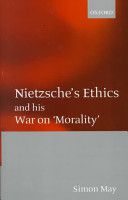
Nietzsche famously attacked traditional morality, and propounded a controversial ethics of ‘life-enhancement’. Simon May presents a radically new view of Nietzsche’s thought, which is shown to be both revolutionary and conservative, and to have much to offer us today after the demise of old values and the ‘death of God’.
Celadon, a poor nation on a poor planet, engaged in civil war and a haven for every type of villainy in space, is ripe for cleanup. The military could pacify it handily, but it would take a statesman to fix it.But some statesmen have ethics, which politicians and megacorps find inconvenient. President Bishwanath compounded the sin by being astute, ambitious and capable. Something had to be done, because a working nation isn’t much use for pork and graft.When the word comes down that he is dead, the politicians move on with a new plan, re-allocating resources, and finding a new, more pliable president to put in place.There are three problems with this solution. Bishwanath is not dead. His mercenary bodyguards are more loyal than the politicians. And if they’re not on contract, there are no rules.
Understanding human beings and their distinctive rational and volitional capacities is one of the central tasks of philosophy. The task requires a clear account of such things as reasons, desires, emotions and motives, and of how they combine to produce and explain human behaviour. In Kinds of Reasons, Maria Alvarez offers a fresh and incisive treatment of these issues, focusing in particular on reasons as they feature in contexts of agency. Her account builds on some important recent work in the area; but she takes her main inspiration from the tradition that receives its seminal contemporary expression in the writings of G.E.M. Anscombe, a tradition that runs counter to the broadly Humean orthodoxy that has dominated the theory of action for the past forty years. Alvarez’s conclusions are therefore likely to be controversial; and her bold and painstaking arguments will be found provocative by participants on every side of the debates with which she engages. Clear and directly written, Kinds of Reasons aims to stake out a distinctive position within one of the most hotly contested areas of contemporary philosophy.
The idea that we are in some significant sense responsible for our emotions is an idea that Robert Solomon has developed for almost three decades. Here, in a single volume, he traces the development of this theory of emotions and elaborate it in detail. Two themes run through his work: the first presents a “cognitive” theory of emotions in which emotions are construed primarily as evaluative judgments. The second proposes an “existentialist” perspective in which he defends the idea that, as we are responsible for our emotions. Indeed, sometimes it even makes sense to say that we “choose” them. While the first claim has gained increasing currency in the literature, his claim about responsibility for emotions has continued to meet with considerable resistance and misinterpretation. The new emphasis on evolutionary biology and neurology has (mistakenly) reinforced the popular prejudice that emotions “happen” to us and are entirely beyond our control. This volume is also a kind of intellectual memoir of Solomon1s own development as a thinker. The essays written in the 1980s elaborate the themes of the “intentionality” of emotion and the claim that emotions are “judgments”; in this period, he is also increasingly preoccupied with how emotions vary and are identified in a variety of cultures. In the 1990’s, his interests evolve to consider the social and political role of emotions and theories about emotion. The final section presents his current philosophical position on the seeming “passivity” of the passions. Despite his own critical assessment of his earlier work, he continues to argue that, in the final analysis, we are responsible for our emotions and existential quality of our lives.
At the core of Kant’s ethics lies the claim that if there is a supreme principle of morality, then it is not a utilitarian or Aristotelian perfectionist principle, or even a principle resembling the Ten Commandments. The only viable candidate for the supreme principle of morality is the Categorial Imperative. This book is the most detailed investigation of thie claim. It constructs a new, criterial reading of Kant’s derivation of one version of the Categorial Imperative: The Formula of Universal Law. This reading shows this derivation to be far more compelling than contemporary philosophers tend to believe. It also reveals a novel approach to deriving another version of the Categorial Imperative, the Formula of Humanity, a principle widely considered to be the most attractive Kantian candidate for the supreme principle of morality. Lucidly written and dealing with a foundational topic in the history of ethics, this book will be important not just for Kant scholars but for a broad swath of students of philosophy. Samuel Kerstein is Associate Professor of Philosophy at the University of Maryland, College Park
ما از اخلاق چه انتظاری داریم؟ این سوال شاید تاحدودی برای عموم مردم و یا متخصصان این رشته قابل پاسخ باشد؛ اینکه خوب بودن را به ما بیاموزد و در تنظیم روابط فردی م...

جشن کتاب تهران به ایستگاه سی و یکم رسیده است. حال و احوال نشر کتاب خوب نیست و باید فرهنگدوستان را به خرید و هدیه دادن کتاب ترغیب نمود. خانه اخلاقپژوهان جوان ب...

بنیاد کتابهای اخلاق اسلامی عمدتا پالایش جان از آلودگیها و آراستن آن به زیباییها است. اندیشه محوری این قبیل کتابها آن است که انسان فعلی آنی نیست که باید باشد...

-
0 Comments