Notice: تابع WP_Block_Type_Registry::register به طورنادرست فراخوانی شد. نامهای نوع بلوک نباید حروف بزرگ داشته باشند. لطفاً برای اطلاعات بیشتر، اشکال زدایی در وردپرس را مشاهده کنید. (این پیام در نگارش 5.0.0 افزوده شده است.) in /home/ethicsho/public_html/wp-includes/functions.php on line 5313
Warning: Use of undefined constant TDC_PATH_LEGACY - assumed 'TDC_PATH_LEGACY' (this will throw an Error in a future version of PHP) in /home/ethicsho/public_html/wp-content/plugins/td-composer/td-composer.php on line 109
Warning: Use of undefined constant TDSP_THEME_PATH - assumed 'TDSP_THEME_PATH' (this will throw an Error in a future version of PHP) in /home/ethicsho/public_html/wp-content/plugins/td-composer/td-composer.php on line 113 بایگانیهای 2445 - خانه اخلاق پژوهان جوان Notice: Trying to access array offset on value of type bool in /home/ethicsho/public_html/wp-content/plugins/wp-ulike/inc/general-functions.php on line 807
Because of the didactic nature of the historical genre, many scholars ancient and modern have seen connections between history and rhetoric. So far, discussion has centered on fifth-century authors — Herodotus and Thucydides, along with the sophists and early philosophers. Pownall extends the focus of this discussion into an important period. By focusing on key intellectuals and historians of the fourth century (Plato and the major historians — Xenophon, Ephorus, and Theopompus), she examines how these prose writers created an aristocratic version of the past as an alternative to the democratic version of the oratorical tradition.Frances Pownall is Professor of History and Classics, University of Alberta.
John Rawls is the preeminent political philosopher of our time. His 1971 masterpiece, A Theory of Justice, permanently changed the landscape of moral political theory, revitalizing the normative study of social issues and taking stands about justice, ethics, rationality and philosophical method that continue to draw followers and critics today.In these five volumes, Henry S. Richardson and Paul Weithman draw together almost 90 of the most incisive and influential articles in that body of literature. The reprinted articles, many of them drawn from difficult-to-find sources, cover the gamut of controversies and conversations sparked by Rawls’s work and represent a wide range of philosophical points of view. The selection also includes articles that reflect Rawls’s reception in economics, law, and the social science more broadly.The publication of these five volumes will be welcomed by students and scholars of contemporary political philosophy, and by anyone interested in the most probing reactions to the premier political philosopher of our time.
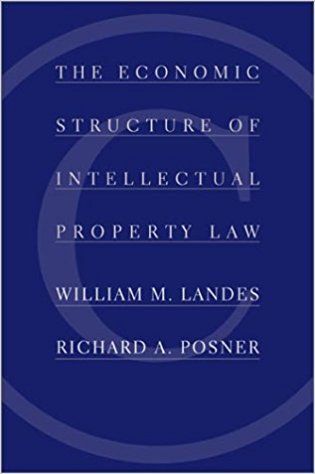
This book takes a fresh look at the most dynamic area of American law today, comprising the fields of copyright, patent, trademark, trade secrecy, publicity rights, and misappropriation. Topics range from copyright in private letters to defensive patenting of business methods, from moral rights in the visual arts to the banking of trademarks, from the impact of the court of patent appeals to the management of Mickey Mouse. The history and political science of intellectual property law, the challenge of digitization, the many statutes and judge-made doctrines, and the interplay with antitrust principles are all examined. The treatment is both positive (oriented toward understanding the law as it is) and normative (oriented to the reform of the law). Previous analyses have tended to overlook the paradox that expanding intellectual property rights can effectively reduce the amount of new intellectual property by raising the creators’ input costs. Those analyses have also failed to integrate the fields of intellectual property law. They have failed as well to integrate intellectual property law with the law of physical property, overlooking the many economic and legal-doctrinal parallels.This book demonstrates the fundamental economic rationality of intellectual property law, but is sympathetic to critics who believe that in recent decades Congress and the courts have gone too far in the creation and protection of intellectual property rights.
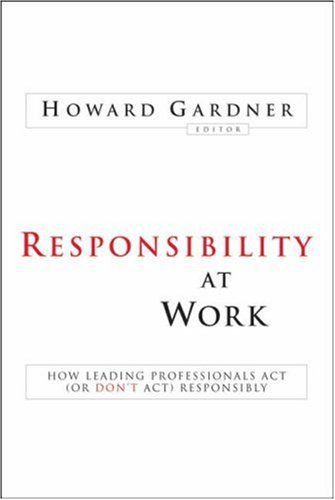
Responsibilityat WorkMost persons strive to produce work that is of excellent technical quality, is pursued in an ethical and socially responsible way, and has the qualities of being engaging and meaningful. How can we attain this ideal of good work in a world that changes so rapidly and all too often features an ethically compromised milieu? Filled with original essays by Howard Gardner, William Damon, Mihaly Csikszentmihalyi, and Jeanne Nakamura and based on a large-scale research project, the GoodWork(R) Project, Responsibility at Work reflects the information gleaned from in-depth interviews with more than 1,200 people from nine different professions–journalism, genetics, theatre, higher education, philanthropy, law, medicine, business, and precollegiate education. The book reveals how motivation, culture, and professional norms can intersect to produce work that is personally, socially, and economically beneficial.?At the heart of the study is the revelation that the key to good work is responsibilty–taking ownership for one’s work and its wider impact.The authors examine how responsibility for work is shaped by both personal and professional components and explore the factors that cause a sense of responsibility, the obstacles that lead to compromised work, and the educational interventions that can lead to a greater sense of responsibility. Most important, this volume provides strategies for cultivating greater responsibility in both seasoned workers as well as the young people who will one day enter the workplace.?
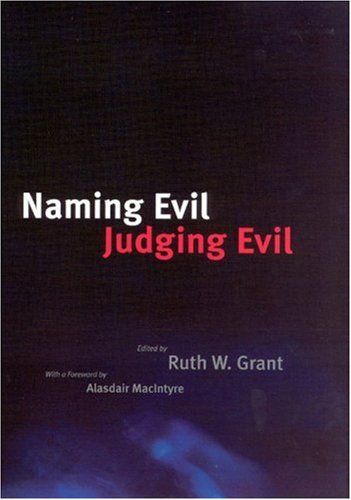
Is it more dangerous to call something evil or not to? This fundamental question deeply divides those who fear that the term oversimplifies grave problems and those who worry that, to effectively address such issues as terrorism and genocide, we must first acknowledge them as evil. Recognizing that the way we approach this dilemma can significantly affect both the harm we suffer and the suffering we inflict, a distinguished group of contributors engages in the debate with this series of timely and original essays. Drawing on Western conceptions of evil from the Middle Ages to the present, these pieces demonstrate that, while it may not be possible to definitively settle moral questions, we are still ableand in fact are obligatedto make moral arguments and judgments. Using a wide variety of approaches, the authors raise tough questions: Why is so much evil perpetrated in the name of good? Could evil ever be eradicated? How can liberal democratic politics help us strike a balance between the need to pass judgment and the need to remain tolerant? Their insightful answers exemplify how the sometimes rarefied worlds of political theory, philosophy, theology, and history can illuminate pressing contemporary concerns.
ما از اخلاق چه انتظاری داریم؟ این سوال شاید تاحدودی برای عموم مردم و یا متخصصان این رشته قابل پاسخ باشد؛ اینکه خوب بودن را به ما بیاموزد و در تنظیم روابط فردی م...

جشن کتاب تهران به ایستگاه سی و یکم رسیده است. حال و احوال نشر کتاب خوب نیست و باید فرهنگدوستان را به خرید و هدیه دادن کتاب ترغیب نمود. خانه اخلاقپژوهان جوان ب...

بنیاد کتابهای اخلاق اسلامی عمدتا پالایش جان از آلودگیها و آراستن آن به زیباییها است. اندیشه محوری این قبیل کتابها آن است که انسان فعلی آنی نیست که باید باشد...

-
0 Comments