Notice: تابع WP_Block_Type_Registry::register به طورنادرست فراخوانی شد. نامهای نوع بلوک نباید حروف بزرگ داشته باشند. لطفاً برای اطلاعات بیشتر، اشکال زدایی در وردپرس را مشاهده کنید. (این پیام در نگارش 5.0.0 افزوده شده است.) in /home/ethicsho/public_html/wp-includes/functions.php on line 5313
Warning: Use of undefined constant TDC_PATH_LEGACY - assumed 'TDC_PATH_LEGACY' (this will throw an Error in a future version of PHP) in /home/ethicsho/public_html/wp-content/plugins/td-composer/td-composer.php on line 109
Warning: Use of undefined constant TDSP_THEME_PATH - assumed 'TDSP_THEME_PATH' (this will throw an Error in a future version of PHP) in /home/ethicsho/public_html/wp-content/plugins/td-composer/td-composer.php on line 113 بایگانیهای 2389 - خانه اخلاق پژوهان جوان Notice: Trying to access array offset on value of type bool in /home/ethicsho/public_html/wp-content/plugins/wp-ulike/inc/general-functions.php on line 807
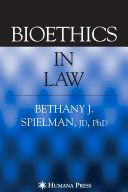
This groundbreaking volume is the first to analyze how and to what extent bioethics considerations influence today’s judges. Previous books have attended to the law that governs bioethics problems, but Bioethics in Law is the first to examine when and how bioethical issues impact judicial reasoning and decision-making. The author undertakes careful analysis of health care committee recommendations, institutional review board determinations, bioethics commission reports, bioethics research materials, briefs of bioethics amicus curiae, and bioethics expert testimony that has been used in legal proceedings during the last decade. Through such examination, Bioethics in Law is able to offer critical insight into the ways that judges have invited, accepted, relied on, followed, critiqued, ignored, rejected, overridden, transformed, and otherwise responded to bioethics communications. This volume is the on the cutting-edge of the relationship of bioethics to law, and explores how law receives, assesses, and uses bioethics. Unlike previous treatments, which perceive the relationship between law and bioethics in an abstract or idealized sense, this book presents actual communications that have found their way to law, and then analyzes their effect on judicial outcomes.
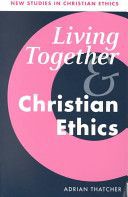
Living Together and Christian Ethics is the first positive, in-depth study of cohabitation outside marriage from a mainstream Christian theological perspective. The book retrieves the traditions of betrothal from the Bible and church history, and shows how these can transform Christian attitudes to living together before marriage. A crucial distinction is made between prenuptial cohabitation where marriage is intended, and nonnuptial cohabitation where it is avoided. Since betrothal was widely understood as a real beginning of marriage, the book argues for a complete pastoral, theological and liturgical renewal that reclaims the riches of forgotten Christian marital traditions and redeploys them in conveying the good news of the faith to women and men who are not yet married. The book takes issue with theologians who marginalize marriage, and suggests that the recognition of marital values can act as a helpful bridge between Christian teaching and people who are not formally married.
In Oughts and Thoughts, Anandi Hattiangadi provides an innovative response to the argument for meaning skepticism set out by Saul Kripke in Wittgenstein on Rules and Private Language. Kripke asks what makes it the case that anybody ever means anything by any word, and argues that there are no facts of the matter as to what anybody ever means. Kripke’s argument has inspired a lively and extended debate in the philosophy of language, as it raises some of the most fundamental issues in the field: namely, the reality, privacy, and normativity of meaning. Hattiangadi argues that in order to achieve the radical conclusion that there are no facts as to what a person means by a word, the skeptic must rely on the thesis that meaning is normative, and that this thesis fails. Since any “skeptical solution” to the skeptical problem is irremediably incoherent, Hattiangadi concludes that there must be a fact of the matter about what we mean. In addition to providing an overview of the debate on meaning and content skepticism, Hattiangadi presents a detailed discussion of the contributions made by Simon Blackburn, Paul Boghossian, Robert Brandom, Fred Dretske, John McDowell, and Crispin Wright, among others, to the controversy surrounding Kripke’s argument. The issues considered include the normativity of meaning and its relation to the normativity of moral judgments, reductive and non-reductive theories of meaning, deflationism about truth and meaning, and the privacy of meaning.
ما از اخلاق چه انتظاری داریم؟ این سوال شاید تاحدودی برای عموم مردم و یا متخصصان این رشته قابل پاسخ باشد؛ اینکه خوب بودن را به ما بیاموزد و در تنظیم روابط فردی م...

جشن کتاب تهران به ایستگاه سی و یکم رسیده است. حال و احوال نشر کتاب خوب نیست و باید فرهنگدوستان را به خرید و هدیه دادن کتاب ترغیب نمود. خانه اخلاقپژوهان جوان ب...

بنیاد کتابهای اخلاق اسلامی عمدتا پالایش جان از آلودگیها و آراستن آن به زیباییها است. اندیشه محوری این قبیل کتابها آن است که انسان فعلی آنی نیست که باید باشد...

-
0 Comments