Notice: تابع WP_Block_Type_Registry::register به طورنادرست فراخوانی شد. نامهای نوع بلوک نباید حروف بزرگ داشته باشند. لطفاً برای اطلاعات بیشتر، اشکال زدایی در وردپرس را مشاهده کنید. (این پیام در نگارش 5.0.0 افزوده شده است.) in /home/ethicsho/public_html/wp-includes/functions.php on line 5313
Warning: Use of undefined constant TDC_PATH_LEGACY - assumed 'TDC_PATH_LEGACY' (this will throw an Error in a future version of PHP) in /home/ethicsho/public_html/wp-content/plugins/td-composer/td-composer.php on line 109
Warning: Use of undefined constant TDSP_THEME_PATH - assumed 'TDSP_THEME_PATH' (this will throw an Error in a future version of PHP) in /home/ethicsho/public_html/wp-content/plugins/td-composer/td-composer.php on line 113 بایگانیهای 2388 - خانه اخلاق پژوهان جوان Notice: Trying to access array offset on value of type bool in /home/ethicsho/public_html/wp-content/plugins/wp-ulike/inc/general-functions.php on line 807
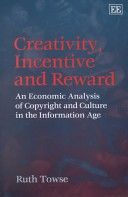
‘…well written, clear and informative. It contains many references that demonstrate the deep knowledge of the field that the author has acquired through her own research and her remarkable work at the head of the Journal of Cultural Economics. She especially provides a very clear review of the literature on the economics of copyright…. this review will become a reference that can’t be ignored by researchers interested in copyright…Towse opens avenues for further research and also stresses those questions that can help professionals better understand cultural regulations.’ – Françoise Benhamou, Journal of Cultural Economics ‘Ruth Towse’s book provides an easily accessible introduction to this field and contains much useful argument. It also stands as testament to the productive and continuing scholarly career of one of the best known figures in contemporary cultural economics.’ – David Throsby, Journal of Economic Literature ‘This is a most interesting treatise on a very topical subject of economic and legal policy …this book offers a wealth of intriguing research ideas and some interesting, if not highly rigorous, analyses of an important area of public policy.’ – Mary Kokoski, Monthly Labor Review ‘Ruth Towse’s excellent book, Creativity, Incentive and Reward is a beacon in this confused theoretical and policy mish-mash. The book, which brings together Towse’s work in copyright and cultural economics over the last decade, is thoroughly researched, analytically satisfying and beautifully written…copyright scholars owe a debt of gratitude to Towse.’ – Fiona Macmillan, Copyright World ‘This is an important work on compensation of the artist and the incentives for artistic activity. The explosive evolution of the technology of communications raises particularly pressing issues in this arena and poses new threats to remuneration of the artist. The discussion of copyright in this book provides vital information for analysis of this issue. The book is informative, intelligent and well written – precisely what is needed for understanding of its subject.’ – William J. Baumol, New York University and Princeton University, US Creativity is crucial to the Information Age economy. It is the basis of production in the cultural industries. In this excellent book, Ruth Towse provides an analysis of the interaction between creativity, the law, and markets for cultural goods and services. Copyright law establishes property rights that create economic incentives to cultural production and Ruth Towse uses her analysis to draw conclusions about policy on copyright. This unique study is of interest to a range of disciplines in economics, law, cultural studies and management.
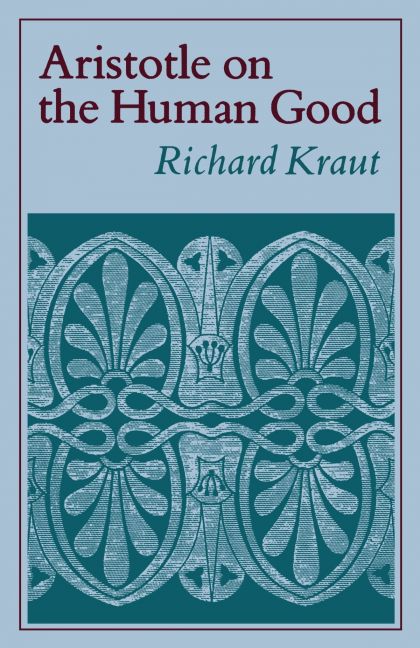
Aristotle’s Nicomachean Ethics, which equates the ultimate end of human life with happiness (eudaimonia), is thought by many readers to argue that this highest goal consists in the largest possible aggregate of intrinsic goods. Richard Kraut proposes instead that Aristotle identifies happiness with only one type of good: excellent activity of the rational soul. In defense of this reading, Kraut discusses Aristotle’s attempt to organize all human goods into a single structure, so that each subordinate end is desirable for the sake of some higher goal.This book also emphasizes the philosopher’s hierarchy of natural kinds, in which every type of creature achieves its good by imitating divine life. As Kraut argues, Aristotle’s belief that thinking is the sole activity of the gods leads him to an intellectualist conception of the ethical virtues. Aristotle values these traits because, by subordinating emotion to reason, they enhance our ability to lead a life devoted to philosophy or politics.
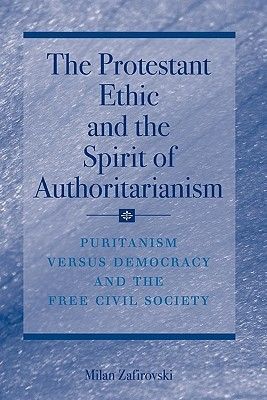
This book explores the historical and contemporary relationships of Protestant Puritanism to political and social authoritarianism. It focuses on Puritanism’s original, subsequent and modern influences on and legacies in political democracy and civil society within historically Puritan Western societies, with emphasis on Great Britain and particularly America, from the 17th to the 21th century. The Protestant Ethic and the Spirit of Authoritarianism: Puritanism, Democracy and Society’s importance and novelty lie in its original theoretical argument and empirical demonstration that Puritanism constitutes or reproduces political-social authoritarianism rather than liberal-secular political democracy and free civil society, contrary to the conventional wisdom in Puritan societies, especially America. The book’s methodological approach is thoroughly interdisciplinary by integrating methods, theories and data in sociology with those in other social sciences such as political science, history and economics. In addition, the book uses a comparative-historical method through comparisons of Western (and other) societies at various points of history in terms of the impact of Puritanism on authoritarianism.
Robert B. Brandom is one of the most original philosophers of our day, whose book Making It Explicit covered and extended a vast range of topics in metaphysics, epistemology, and philosophy of language–the very core of analytic philosophy. This new work provides an approachable introduction to the complex system that Making It Explicit mapped out. A tour of the earlier book’s large ideas and relevant details, Articulating Reasons offers an easy entry into two of the main themes of Brandom’s work: the idea that the semantic content of a sentence is determined by the norms governing inferences to and from it, and the idea that the distinctive function of logical vocabulary is to let us make our tacit inferential commitments explicit.Brandom’s work, making the move from representationalism to inferentialism, constitutes a near-Copernican shift in the philosophy of language–and the most important single development in the field in recent decades. Articulating Reasons puts this accomplishment within reach of nonphilosophers who want to understand the state of the foundations of semantics.
ما از اخلاق چه انتظاری داریم؟ این سوال شاید تاحدودی برای عموم مردم و یا متخصصان این رشته قابل پاسخ باشد؛ اینکه خوب بودن را به ما بیاموزد و در تنظیم روابط فردی م...

جشن کتاب تهران به ایستگاه سی و یکم رسیده است. حال و احوال نشر کتاب خوب نیست و باید فرهنگدوستان را به خرید و هدیه دادن کتاب ترغیب نمود. خانه اخلاقپژوهان جوان ب...

بنیاد کتابهای اخلاق اسلامی عمدتا پالایش جان از آلودگیها و آراستن آن به زیباییها است. اندیشه محوری این قبیل کتابها آن است که انسان فعلی آنی نیست که باید باشد...

-
0 Comments