Notice: تابع WP_Block_Type_Registry::register به طورنادرست فراخوانی شد. نامهای نوع بلوک نباید حروف بزرگ داشته باشند. لطفاً برای اطلاعات بیشتر، اشکال زدایی در وردپرس را مشاهده کنید. (این پیام در نگارش 5.0.0 افزوده شده است.) in /home/ethicsho/public_html/wp-includes/functions.php on line 5313
Warning: Use of undefined constant TDC_PATH_LEGACY - assumed 'TDC_PATH_LEGACY' (this will throw an Error in a future version of PHP) in /home/ethicsho/public_html/wp-content/plugins/td-composer/td-composer.php on line 109
Warning: Use of undefined constant TDSP_THEME_PATH - assumed 'TDSP_THEME_PATH' (this will throw an Error in a future version of PHP) in /home/ethicsho/public_html/wp-content/plugins/td-composer/td-composer.php on line 113 بایگانیهای 2363 - خانه اخلاق پژوهان جوان Notice: Trying to access array offset on value of type bool in /home/ethicsho/public_html/wp-content/plugins/wp-ulike/inc/general-functions.php on line 807
What makes people cosmopolitan? How is cosmopolitanism shaping everyday life experiences and the practices of ordinary people?Making use of empirical research, “Cosmopolitanism in Practice” examines the concrete settings in which individuals display cosmopolitan sensibilities and dispositions, illustrating the ways in which cosmopolitan self-transformations can be used as an analytical tool to explain a variety of identity outlooks and practices. The manner in which both past and present cosmopolitanisms compete with meta-narratives such as nationalism, multiculturalism and religion is also investigated, alongside the employment of cosmopolitan ideas in situations of tension and conflict.With an international team of contributors, including Ulrich Beck, Steven Vertovec, Rob Kroes and Natan Sznaider, this book draws on a variety of intellectual disciplines and international contexts to show how people embrace and make use of cosmopolitan ideas and attitudes.
Robert B. Brandom is one of the most original philosophers of our day, whose book Making It Explicit covered and extended a vast range of topics in metaphysics, epistemology, and philosophy of language–the very core of analytic philosophy. This new work provides an approachable introduction to the complex system that Making It Explicit mapped out. A tour of the earlier book’s large ideas and relevant details, Articulating Reasons offers an easy entry into two of the main themes of Brandom’s work: the idea that the semantic content of a sentence is determined by the norms governing inferences to and from it, and the idea that the distinctive function of logical vocabulary is to let us make our tacit inferential commitments explicit.Brandom’s work, making the move from representationalism to inferentialism, constitutes a near-Copernican shift in the philosophy of language–and the most important single development in the field in recent decades. Articulating Reasons puts this accomplishment within reach of nonphilosophers who want to understand the state of the foundations of semantics.
Nearly a century before the advent of “multiculturalism,” Jane Addams put forward her conception of the moral significance of diversity. Each member of a democracy, Addams believed, is under a moral obligation to seek out diverse experiences, making a daily effort to confront others’ perspectives. Morality must be seen as a social rather than an individual endeavour, and democracy as a way of life rather than merely a basis for laws. Failing this, both democracy and ethics remain sterile, empty concepts.In this, Addams’ earliest book on ethics – presented here with a substantial introduction by Charlene Haddock Seigfried – she reflects on the factors that hinder the ability of all members of society to determine their own well-being. Observing relationships between charitable workers and their clients, between factory owners and their employers, and between household employers and their servants, she identifies sources of friction and shows how conceiving of democracy as a social obligation can lead to new, mutually beneficial lines of conduct.She also considers the proper education of workers, struggles between parents and their adult daughters over conflicting family and social claims, and the merging of politics with the daily lives of constituents. “The sphere of morals is the sphere of action”, Addams proclaims. It is not enough to believe passively in the innate dignity of all human beings. Rather, one must work daily to root out racial, gender, class, and other prejudices from personal relationships.
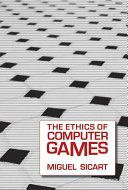
Despite the emergence of computer games as a dominant cultural industry (and the accompanying emergence of computer games as the subject of scholarly research), we know little or nothing about the ethics of computer games. Considerations of the morality of computer games seldom go beyond intermittent portrayals of them in the mass media as training devices for teenage serial killers. In this first scholarly exploration of the subject, Miguel Sicart addresses broader issues about the ethics of games, the ethics of playing the games, and the ethical responsibilities of game designers. He argues that computer games are ethical objects, that computer game players are ethical agents, and that the ethics of computer games should be seen as a complex network of responsibilities and moral duties. Players should not be considered passive amoral creatures; they reflect, relate, and create with ethical minds. The games they play are ethical systems, with rules that create gameworlds with values at play.Drawing on concepts from philosophy and game studies, Sicart proposes a framework for analyzing the ethics of computer games as both designed objects and player experiences. After presenting his core theoretical arguments and offering a general theory for understanding computer game ethics, Sicart offers case studies examining single-player games (using Bioshock as an example), multiplayer games (illustrated by Defcon), and online gameworlds (illustrated by World of Warcraft) from an ethical perspective. He explores issues raised by unethical content in computer games and its possible effect on players and offers a synthesis of design theory and ethics that could be used as both analytical tool and inspiration in the creation of ethical gameplay.
ما از اخلاق چه انتظاری داریم؟ این سوال شاید تاحدودی برای عموم مردم و یا متخصصان این رشته قابل پاسخ باشد؛ اینکه خوب بودن را به ما بیاموزد و در تنظیم روابط فردی م...

جشن کتاب تهران به ایستگاه سی و یکم رسیده است. حال و احوال نشر کتاب خوب نیست و باید فرهنگدوستان را به خرید و هدیه دادن کتاب ترغیب نمود. خانه اخلاقپژوهان جوان ب...

بنیاد کتابهای اخلاق اسلامی عمدتا پالایش جان از آلودگیها و آراستن آن به زیباییها است. اندیشه محوری این قبیل کتابها آن است که انسان فعلی آنی نیست که باید باشد...

-
0 Comments