Notice: تابع WP_Block_Type_Registry::register به طورنادرست فراخوانی شد. نامهای نوع بلوک نباید حروف بزرگ داشته باشند. لطفاً برای اطلاعات بیشتر، اشکال زدایی در وردپرس را مشاهده کنید. (این پیام در نگارش 5.0.0 افزوده شده است.) in /home/ethicsho/public_html/wp-includes/functions.php on line 5313
Warning: Use of undefined constant TDC_PATH_LEGACY - assumed 'TDC_PATH_LEGACY' (this will throw an Error in a future version of PHP) in /home/ethicsho/public_html/wp-content/plugins/td-composer/td-composer.php on line 109
Warning: Use of undefined constant TDSP_THEME_PATH - assumed 'TDSP_THEME_PATH' (this will throw an Error in a future version of PHP) in /home/ethicsho/public_html/wp-content/plugins/td-composer/td-composer.php on line 113 بایگانیهای 2084 - خانه اخلاق پژوهان جوان Notice: Trying to access array offset on value of type bool in /home/ethicsho/public_html/wp-content/plugins/wp-ulike/inc/general-functions.php on line 807
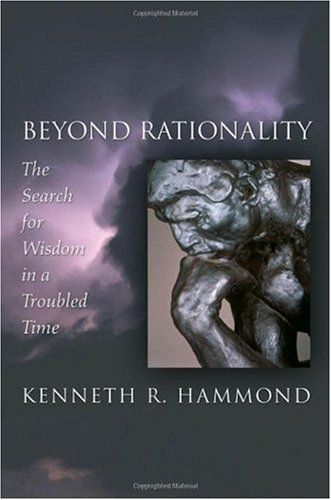
With Beyond Rationality, Kenneth R. Hammond, one of the most respected and experienced experts in judgment and decision-making, sums up his life’s work and persuasively argues that decisions should be based on balance and pragmatism rather than rigid ideologies. Hammond has long focused on the dichotomy between theories of correspondence, whereby arguments correspond with reality, and coherence, whereby arguments strive to be internally consistent. He has persistently proposed a middle approach that draws from both of these modes of thought and so avoids the blunders of either extreme. In this volume, Hammond shows how particular ways of thinking that are common in the political process have led to the mistaken judgments that created our current political crisis. He illustrates this argument by analyzing penetrating case studies emphasizing the political consequences that arise when decision makers consciously or unconsciously ignore their adversaries’ particular mode of thought. These analyses range from why Kennedy and Khruschev misunderstood each other to why Colin Powell erred in his judgments over the presence of weapons of mass destruction in Iraq. For anyone concerned about the current state of politics in the U.S. and where it will lead us, Beyond Rationality is required reading.
“Chris Anderson’s initial L̀ong Tail’ analysis was released in 2004 just as the wave of mergers and acquisitions was sweeping the music publishing and radio industries. Music industry executives began looking for Anderson’s L̀ong Tail’ effect and with it the implied redistribution of royalty income from popular songs to long dormant and forgotten works in their catalogs. These music publishers had hoped to further maximize the value of their copyright assets (lyrics and melody) in their existing music catalogs as the sale of compact disks diminished, and consumers switched their purchasing and listening habits to new digital formats in music technology such as the iPod.” “This book deals with the measurement of skewness, heavy tails and asymmetry in performance royalty income data in the music industry from an Economics of Art and Culture perspective. The book is divided into two parts. The first part is a general introduction to the many supply and demand economic factors that are related to music performance royalty payments. The second part is an applied econometrics section that provides modeling and in-depth analysis of income data from a songwriter, music publisher and blanket licensing perspective. The book will appeal to researchers and students in cultural economics, media and statistics as well as general readers and professionals in the music publishing industry.” “As a Senior Economist for the American Society of Composers, Authors, and Publishers (ASCAP) using both internal and licensed external proprietary data, the author found that the so-called s̀uperstar effects’ are still present in performance royalty income. Success is still concentrated on a relatively few copyright holders or members who can be grouped into h̀eavy tails’ of the empirical income distribution in a departure from Anderson’s L̀ong Tail’ analysis.”.
How do we judge whether an action is morally right or wrong? If an action is wrong, what reason does that give us not to do it? Why should we give such reasons priority over our other concerns and values? In this book, T. M. Scanlon offers new answers to these questions, as they apply to the central part of morality that concerns what we owe to each other. According to his contractualist view, thinking about right and wrong is thinking about what we do in terms that could be justified to others and that they could not reasonably reject. He shows how the special authority of conclusions about right and wrong arises from the value of being related to others in this way, and he shows how familiar moral ideas such as fairness and responsibility can be understood through their role in this process of mutual justification and criticism.Scanlon bases his contractualism on a broader account of reasons, value, and individual well-being that challenges standard views about these crucial notions. He argues that desires do not provide us with reasons, that states of affairs are not the primary bearers of value, and that well-being is not as important for rational decision-making as it is commonly held to be. Scanlon is a pluralist about both moral and non-moral values. He argues that, taking this plurality of values into account, contractualism allows for most of the variability in moral requirements that relativists have claimed, while still accounting for the full force of our judgments of right and wrong.
ما از اخلاق چه انتظاری داریم؟ این سوال شاید تاحدودی برای عموم مردم و یا متخصصان این رشته قابل پاسخ باشد؛ اینکه خوب بودن را به ما بیاموزد و در تنظیم روابط فردی م...

جشن کتاب تهران به ایستگاه سی و یکم رسیده است. حال و احوال نشر کتاب خوب نیست و باید فرهنگدوستان را به خرید و هدیه دادن کتاب ترغیب نمود. خانه اخلاقپژوهان جوان ب...

بنیاد کتابهای اخلاق اسلامی عمدتا پالایش جان از آلودگیها و آراستن آن به زیباییها است. اندیشه محوری این قبیل کتابها آن است که انسان فعلی آنی نیست که باید باشد...

-
0 Comments