Notice: تابع WP_Block_Type_Registry::register به طورنادرست فراخوانی شد. نامهای نوع بلوک نباید حروف بزرگ داشته باشند. لطفاً برای اطلاعات بیشتر، اشکال زدایی در وردپرس را مشاهده کنید. (این پیام در نگارش 5.0.0 افزوده شده است.) in /home/ethicsho/public_html/wp-includes/functions.php on line 5313
Warning: Use of undefined constant TDC_PATH_LEGACY - assumed 'TDC_PATH_LEGACY' (this will throw an Error in a future version of PHP) in /home/ethicsho/public_html/wp-content/plugins/td-composer/td-composer.php on line 109
Warning: Use of undefined constant TDSP_THEME_PATH - assumed 'TDSP_THEME_PATH' (this will throw an Error in a future version of PHP) in /home/ethicsho/public_html/wp-content/plugins/td-composer/td-composer.php on line 113 بایگانیهای 174 - خانه اخلاق پژوهان جوان Notice: Trying to access array offset on value of type bool in /home/ethicsho/public_html/wp-content/plugins/wp-ulike/inc/general-functions.php on line 807
Antirealist views about morality claim that moral facts or truths do not exist. Does this imply that other types of normative facts, such as epistemic facts, do not exist? The Normative Web develops a positive answer to this question. Terence Cuneo argues that moral and epistemic facts are sufficiently similar so that, if moral facts do not exist, then epistemic facts do not exist. But epistemic facts do exist: to deny their existence would commit us to an extreme version of epistemological scepticism. Therefore, Cuneo concludes, moral facts do exist. And if moral facts exist, then moral realism is true. It is sometimes said that moral realists rarely offer arguments for their position, settling instead for mere defenses of a view they find intuitively plausible. By contrast, The Normative Web provides not merely a defense of robust realism in ethics, but a positive argument for this position. In so doing, it engages with a range of antirealist positions in epistemology such as error theories, expressivist views, and reductionist views of epistemic reasons. These positions, Cuneo claims, come at a prohibitively high theoretical cost. Given this cost, it follows that realism about both epistemic and moral facts is a position that we should find highly attractive.
Much of the intense current interest in collective memory concerns the politics of memory. In a book that asks, “Is there an ethics of memory?” Avishai Margalit addresses a separate, perhaps more pressing, set of concerns. The idea he pursues is that the past, connecting people to each other, makes possible the kinds of “thick” relations we can call truly ethical. Thick relations, he argues, are those that we have with family and friends, lovers and neighbors, our tribe and our nation–and they are all dependent on shared memories. But we also have “thin” relations with total strangers, people with whom we have nothing in common except our common humanity. A central idea of the ethics of memory is that when radical evil attacks our shared humanity, we ought as human beings to remember the victims. Margalit’s work offers a philosophy for our time, when, in the wake of overwhelming atrocities, memory can seem more crippling than liberating, a force more for revenge than for reconciliation. Morally powerful, deeply learned, and elegantly written, The Ethics of Memory draws on the resources of millennia of Western philosophy and religion to provide us with healing ideas that will engage all of us who care about the nature of our relations to others.
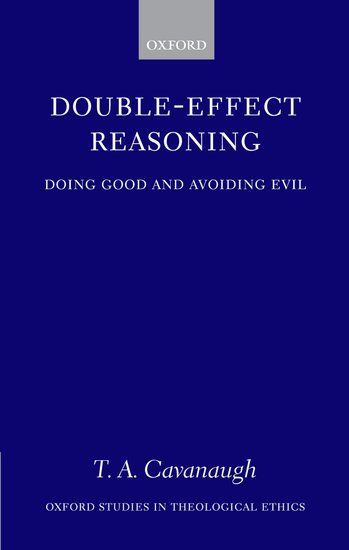
T. A. Cavanaugh defends double-effect reasoning (DER), also known as the principle of double effect. DER plays a role in anti-consequentialist ethics (such as deontology), in hard cases in which one cannot realize a good without also causing a foreseen, but not intended, bad effect (for example, killing non-combatants when bombing a military target). This study is the first book-length account of the history and issues surrounding this controversial approach to hard cases. It will be indispensable in theoretical ethics, applied ethics (especially medical and military), and moral theology. It will also interest legal and public policy scholars.
Governments now face complex dilemmas regarding the promotion of human rights, the punishment of crimes against humanity, and the scope for humanitarian intervention. This book offers a theoretical and empirical analysis of these issues. The contributors explore the meaning of “ethical foreign policy” and look at potential or actual instruments of ethical foreign policy-making. Finally, three case studies examine more closely developments in the foreign policies of the U.S., the U.K., and the European Union, to assess the difficulties raised by the incorporation of ethical considerations into foreign policy.
ما از اخلاق چه انتظاری داریم؟ این سوال شاید تاحدودی برای عموم مردم و یا متخصصان این رشته قابل پاسخ باشد؛ اینکه خوب بودن را به ما بیاموزد و در تنظیم روابط فردی م...

جشن کتاب تهران به ایستگاه سی و یکم رسیده است. حال و احوال نشر کتاب خوب نیست و باید فرهنگدوستان را به خرید و هدیه دادن کتاب ترغیب نمود. خانه اخلاقپژوهان جوان ب...

بنیاد کتابهای اخلاق اسلامی عمدتا پالایش جان از آلودگیها و آراستن آن به زیباییها است. اندیشه محوری این قبیل کتابها آن است که انسان فعلی آنی نیست که باید باشد...

-
0 Comments