Notice: تابع WP_Block_Type_Registry::register به طورنادرست فراخوانی شد. نامهای نوع بلوک نباید حروف بزرگ داشته باشند. لطفاً برای اطلاعات بیشتر، اشکال زدایی در وردپرس را مشاهده کنید. (این پیام در نگارش 5.0.0 افزوده شده است.) in /home/ethicsho/public_html/wp-includes/functions.php on line 5313
Warning: Use of undefined constant TDC_PATH_LEGACY - assumed 'TDC_PATH_LEGACY' (this will throw an Error in a future version of PHP) in /home/ethicsho/public_html/wp-content/plugins/td-composer/td-composer.php on line 109
Warning: Use of undefined constant TDSP_THEME_PATH - assumed 'TDSP_THEME_PATH' (this will throw an Error in a future version of PHP) in /home/ethicsho/public_html/wp-content/plugins/td-composer/td-composer.php on line 113 بایگانیهای 1595 - خانه اخلاق پژوهان جوان Notice: Trying to access array offset on value of type bool in /home/ethicsho/public_html/wp-content/plugins/wp-ulike/inc/general-functions.php on line 807
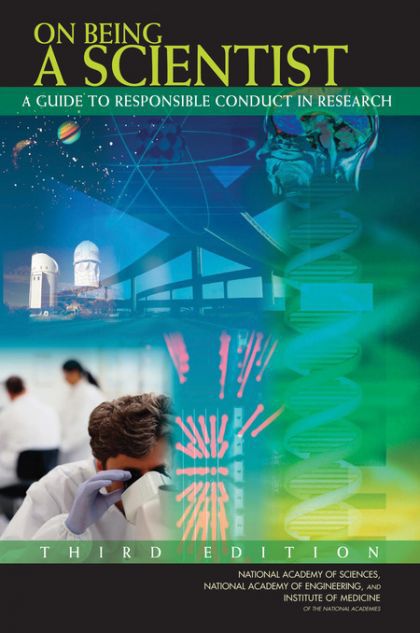
The scientific research enterprise is built on a foundation of trust. Scientists trust that the results reported by others are valid. Society trusts that the results of research reflect an honest attempt by scientists to describe the world accurately and without bias. But this trust will endure only if the scientific community devotes itself to exemplifying and transmitting the values associated with ethical scientific conduct. On Being a Scientist was designed to supplement the informal lessons in ethics provided by research supervisors and mentors. The book describes the ethical foundations of scientific practices and some of the personal and professional issues that researchers encounter in their work. It applies to all forms of research–whether in academic, industrial, or governmental settings-and to all scientific disciplines.
Changing attitudes toward human experimentation along with other controversial moral issues emerged after the Second World War and, in 1963, led to the establishment of the London Medical Group, organized by Ted Shotter, with similar Medical Groups elsewhere from 1967. These became forums for discussion and debate arising from dilemmas encountered in medical settings. Medical ethics did not become a recognized subject in the syllabus of Britain’s medical schools until 1993. This Witness Seminar transcript records the development of international ethical codes, the response to them over the period 1963-93 by students and doctors and the extent of resistance encountered from deans, hospital administrators and others; the Groups’ influence on medical practice; the impact on both Medical Group organizers and participants in their subsequent careers; the local and regional variations and their significant lasting contributions. The meeting was chaired by Dr Stephen Lock and included former Medical Group members, scientists, physicians and policy makers, such as Professors Kenneth Boyd, Bill Fulford, Roger Higgs, Sir Ian Kennedy, David Morton and Sir Malcolm Macnaughton. An introduction by Professor Sir Kenneth Calman and appendices of the Very Revd Edward Shotter’s reflections on the influence of the Medical Groups as a report for the Institute of Medical Ethics complete the transcript.
More than any other field in education, the social and cultural foundations of education reflect many of the conflicts, tensions, and forces in American society. This is hardly surprising, since the area focuses on issues such as race, gender, socioeconomic class, the impact of technology on learning, what it means to be educated, and the role of teaching and learning in a societal context.The Encyclopedia of the Social and Cultural Foundations of Education provides a comprehensive introduction to the social and cultural foundations of education. With more than 400 entries, the three volumes of this indispensable resource offer a thorough and interdisciplinary view of the field for all those interested in issues involving schools and society.Key Features· Provides an interdisciplinary perspective from areas such as comparative education, educational anthropology, educational sociology, the history of education, and the philosophy of education· Presents essays on major movements in the field, including the Free School and Visual Instruction movements· Includes more than 130 biographical entries on important men and women in education· Offers interpretations of legal material including Brown v. Board of Education(1954) and the GI Bill of Rights· Explores theoretical debates fundamental to the field such as religion in the public school curriculum, rights of students and teachers, surveillance in schools, tracking and detracking, and many more · Contains a visual history of American education with nearly 350 images and an accompanying narrativeKey Themes· Arts, Media, and Technology· Curriculum· Economic Issues· Equality and Social Stratification· Evaluation, Testing, and Research Methods· History of Education· Law and Public Policy· Literacy· Multiculturalism and Special Populations· Organizations, Schools, and Institutions· Religion and Social Values· School Governance· Sexuality and Gender· Teachers· Theories, Models, and Philosophical Perspectives· A Visual History of American Education
ما از اخلاق چه انتظاری داریم؟ این سوال شاید تاحدودی برای عموم مردم و یا متخصصان این رشته قابل پاسخ باشد؛ اینکه خوب بودن را به ما بیاموزد و در تنظیم روابط فردی م...

جشن کتاب تهران به ایستگاه سی و یکم رسیده است. حال و احوال نشر کتاب خوب نیست و باید فرهنگدوستان را به خرید و هدیه دادن کتاب ترغیب نمود. خانه اخلاقپژوهان جوان ب...

بنیاد کتابهای اخلاق اسلامی عمدتا پالایش جان از آلودگیها و آراستن آن به زیباییها است. اندیشه محوری این قبیل کتابها آن است که انسان فعلی آنی نیست که باید باشد...

-
0 Comments