Notice: تابع WP_Block_Type_Registry::register به طورنادرست فراخوانی شد. نامهای نوع بلوک نباید حروف بزرگ داشته باشند. لطفاً برای اطلاعات بیشتر، اشکال زدایی در وردپرس را مشاهده کنید. (این پیام در نگارش 5.0.0 افزوده شده است.) in /home/ethicsho/public_html/wp-includes/functions.php on line 5313
Warning: Use of undefined constant TDC_PATH_LEGACY - assumed 'TDC_PATH_LEGACY' (this will throw an Error in a future version of PHP) in /home/ethicsho/public_html/wp-content/plugins/td-composer/td-composer.php on line 109
Warning: Use of undefined constant TDSP_THEME_PATH - assumed 'TDSP_THEME_PATH' (this will throw an Error in a future version of PHP) in /home/ethicsho/public_html/wp-content/plugins/td-composer/td-composer.php on line 113 بایگانیهای 1503 - خانه اخلاق پژوهان جوان Notice: Trying to access array offset on value of type bool in /home/ethicsho/public_html/wp-content/plugins/wp-ulike/inc/general-functions.php on line 807
Each volume of this series of companions to major philosophers contains specially commissioned essays by an international team of scholars, together with a substantial bibliography, and will serve as a reference work for students and non-specialists. One aim of the series is to dispel the intimidation such readers often feel when faced with the work of a difficult and challenging thinker. The essays in this volume provide a systematic survey of Locke’s philosophy informed by the most recent scholarship. They cover Locke’s theory of ideas, his philosophies of body, mind, language, and religion, his theory of knowledge, his ethics, and his political philosophy. There are also chapters on Locke’s life and subsequent influence. New readers and non-specialists will find this the most convenient, accessible guide to Locke currently available.
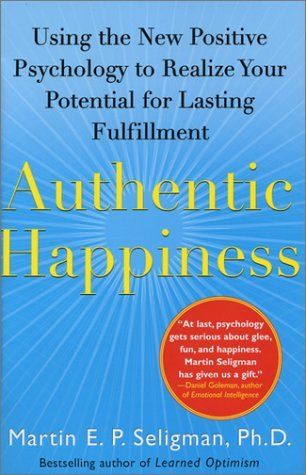
In this national bestseller — Martin Seligman’s most stimulating, persuasive book to date — the acclaimed author of Learned Optimism introduces yet another revolutionary idea. Drawing on groundbreaking scientific research, Seligman shows how Positive Psychology is shifting the profession’s paradigm away from its narrow-minded focus on pathology, victimology, and mental illness to positive emotion and mental health. Happiness, studies show, is not the result of good genes or luck. It can be cultivated by identifying and nurturing traits that we already possess — including kindness, originality, humor, optimism, and generosity.Seligman provides the tools you need in order to ascertain your most positive traits or strengths. Then he explains how, by frequently calling upon these “signature strengths” in all the crucial realms of life — health, relationships, career — you will not only develop natural buffers against misfortune and negative emotion, but also achieve new and sustainable levels of authentic contentment, gratification, and meaning.
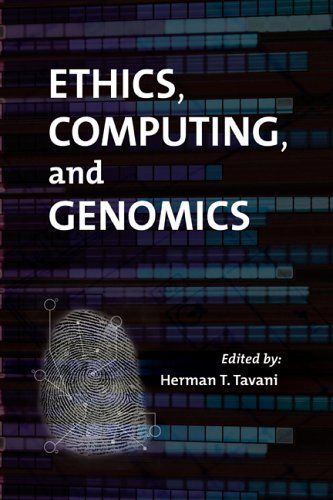
Comprised of eighteen chapters contributed by experts in the fields of biology, computer science, information technology, law, and philosophy, Ethics, Computing, and Genomics provides instructors with a flexible resource for undergraduate and graduate courses in an exciting new field of applied ethics: computational genomics. the chapters are organized in a way that takes the reader from a discussion of conceptual frameworks and methodological perspectives, including ethical theory, To an in-depth analysis of controversial issues involving privacy and confidentiality, information consent, and intellectual property. the volume concludes with some predictions about the future of computational genomics, including the role that nanotechnology will likely play as biotechnologies and information technologies continue to converge.
In this forward-looking volume the invited authors argue that the world must critically assess the potential pitfalls of new technologies in advance. Many of the developments in modern technology are complex, risky, and, to begin with, cloaked in uncertainty. How should we deal with such developments – that may not only have positive effects (such as an increase of our well-being or an improved ability to control and cure diseases) but also negative effects for human beings and the environment (such as global warming or the medicalisation of human beings)? The fact that technological ‘progress’ often occurs under conditions of uncertainty makes the issue even more pressing. Frequently, we are completely devoid of information concerning the applications of new technologies and what their impact will be on human beings and the environment. History has shown that taking a retrospective perspective by passively awaiting the practical consequences of new technologies is both dangerous and inappropriate, as often damage will already have occurred. The genie is well and truly out of the bottle and those who once had control over the new processes no longer have that power, as the science will have a momentum of its own, unheeding of belated attempts to stop it or slow it down. What is more, technology is often ‘logically malleable’, with far wider applications than even we can anticipate. Thus, say editors Sollie and Duwell, an anticipatory attitude is required towards dealing with new technology. This book addresses methodological issues with regard to the ethical evaluation of new and emerging technology. It focuses specifically on the concept of uncertainty that, unlike the notion of risk, is greatly undervalued in the field of ethics. It is a must-read for anyone involved in (ethical) technology assessment: philosophers, those involved in science and technology studies, and policy-makers alike.
ما از اخلاق چه انتظاری داریم؟ این سوال شاید تاحدودی برای عموم مردم و یا متخصصان این رشته قابل پاسخ باشد؛ اینکه خوب بودن را به ما بیاموزد و در تنظیم روابط فردی م...

جشن کتاب تهران به ایستگاه سی و یکم رسیده است. حال و احوال نشر کتاب خوب نیست و باید فرهنگدوستان را به خرید و هدیه دادن کتاب ترغیب نمود. خانه اخلاقپژوهان جوان ب...

بنیاد کتابهای اخلاق اسلامی عمدتا پالایش جان از آلودگیها و آراستن آن به زیباییها است. اندیشه محوری این قبیل کتابها آن است که انسان فعلی آنی نیست که باید باشد...

-
0 Comments