Notice: تابع WP_Block_Type_Registry::register به طورنادرست فراخوانی شد. نامهای نوع بلوک نباید حروف بزرگ داشته باشند. لطفاً برای اطلاعات بیشتر، اشکال زدایی در وردپرس را مشاهده کنید. (این پیام در نگارش 5.0.0 افزوده شده است.) in /home/ethicsho/public_html/wp-includes/functions.php on line 5313
Warning: Use of undefined constant TDC_PATH_LEGACY - assumed 'TDC_PATH_LEGACY' (this will throw an Error in a future version of PHP) in /home/ethicsho/public_html/wp-content/plugins/td-composer/td-composer.php on line 109
Warning: Use of undefined constant TDSP_THEME_PATH - assumed 'TDSP_THEME_PATH' (this will throw an Error in a future version of PHP) in /home/ethicsho/public_html/wp-content/plugins/td-composer/td-composer.php on line 113 بایگانیهای 1457 - خانه اخلاق پژوهان جوان Notice: Trying to access array offset on value of type bool in /home/ethicsho/public_html/wp-content/plugins/wp-ulike/inc/general-functions.php on line 807
The provocative contention of the postmodernist and feminist essays in Ethics of the Body is that conventional bioethics is out of touch, despite its growing profile. It is out of touch with an ongoing phenomenological sense of bodies themselves; with the impact of postmodernist theory as it problematizes the certainties of binary thinking; and with a postmodern culture in which bioscientific developments force us to question what is meant by the notion of the human self. The authors demonstrate that the conventional normative framework of bioethics is called into question by issues as wide ranging as genetic manipulation, disability, high-tech prosthetics, and intersexuality. The essays show how both the theory and practice of bioethics can benefit from postmodernism’s characteristic fluidity and multiplicity, as well as from the insights of a reconceived feminist bioethics. They address issues in philosophy, law, bioscientific research, psychiatry, cultural studies, and feminism from a “postconventional” perspective that looks beyond the familiar ideas of the body, proposing not a bioethics about the body but a radical ethics of the body.After exploring notions of difference in both feminist and postmodernist terms, the book considers specific issues—including HIV, addiction, borderline personality disorder, and cancer—that challenge the principles of conventional bioethics. The focus then turns to questions raised by biotechnology: one essay rethinks the traditional feminist ethics of care in the context of new reproductive technology, while others tackle genetic and genomic issues. Finally, the book looks at embodiment and some specifically anomalous forms of being-in-the-body, including a consideration of intersex infants and children that draws on feminist, postructuralist, and queer theory.
Ethical constraints on relations among individuals within and between societies have always reflected or invoked a higher authority than the caprices of human will. For over two thousand years Natural Law and Natural Rights were the constellations of ideas and presuppositions that fulfilled this role in the west, and exhibited far greater similarities than most commentators want to admit. Such ideas were the lens through which Europeans evaluated the rest of the world. In his major new book David Boucher rejects the view that Natural Rights constituted a secularisation of Natural Law ideas by showing that most of the significant thinkers in the field, in their various ways, believed that reason leads you to the discovery of your obligations, while God provides the ground for discharging them. Furthermore, the book maintains that Natural Rights and Human Rights are far less closely related than is often asserted because Natural Rights never cast adrift the religious foundationalism, whereas Human Rights, for the most part, have jettisoned the Christian metaphysics upon which both Natural Law and Natural Rights depended. Human Rights theories, on the whole, present us with foundationless universal constraints on the actions of individuals, both domestically and internationally. Finally, one of the principal contentions of the book is that these purportedly universal rights and duties almost invariably turn out to be conditional, and upon close scrutiny end up being ‘special’ rights and privileges as the examples of multicultural encounters, slavery and racism, and women’s rights demonstrate.
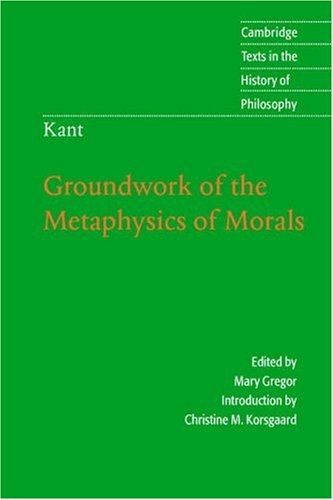
Immanuel Kant’s Groundwork of the Metaphysics of Morals of 1785 is one of the most profound and important works in the history of practical philosophy. In this introduction to the Groundwork, Sally Sedgwick provides a guide to Kant’s text that follows the course of his discussion virtually paragraph by paragraph. Her aim is to convey Kant’s ideas and arguments as clearly and simply as possible, without getting lost in scholarly controversies. Her introductory chapter offers a useful overview of Kant’s general approach to practical philosophy, and she also explores and clarifies some of the main assumptions which Kant relies on in his Groundwork but defends in his Critique of Pure Reason. The book will be a valuable guide for all who are interested in Kant’s practical philosophy.
Resisting Ethics is a new contribution to an ongoing debate on how the world can be improved. Starting with the notion that resistance and ethics are theoretically and practically intertwined, Scott Schaffer develops a new socially oriented ethics based on the practical experience of resistance and ethics. Borrowing from and extending the ideas of Sartre, Merleau-Ponty, and Bourdieu, and using case studies of the Algerian Revolution and the Zapatista rebellion, Schaffer argues that existentialism can give us new insights into how we can and should act ethically in the world. Resisting Ethics is a wide-ranging work and represents a new kind of intervention into issues of social justice and resistance.
ما از اخلاق چه انتظاری داریم؟ این سوال شاید تاحدودی برای عموم مردم و یا متخصصان این رشته قابل پاسخ باشد؛ اینکه خوب بودن را به ما بیاموزد و در تنظیم روابط فردی م...

جشن کتاب تهران به ایستگاه سی و یکم رسیده است. حال و احوال نشر کتاب خوب نیست و باید فرهنگدوستان را به خرید و هدیه دادن کتاب ترغیب نمود. خانه اخلاقپژوهان جوان ب...

بنیاد کتابهای اخلاق اسلامی عمدتا پالایش جان از آلودگیها و آراستن آن به زیباییها است. اندیشه محوری این قبیل کتابها آن است که انسان فعلی آنی نیست که باید باشد...

-
0 Comments