Notice: تابع WP_Block_Type_Registry::register به طورنادرست فراخوانی شد. نامهای نوع بلوک نباید حروف بزرگ داشته باشند. لطفاً برای اطلاعات بیشتر، اشکال زدایی در وردپرس را مشاهده کنید. (این پیام در نگارش 5.0.0 افزوده شده است.) in /home/ethicsho/public_html/wp-includes/functions.php on line 5313
Warning: Use of undefined constant TDC_PATH_LEGACY - assumed 'TDC_PATH_LEGACY' (this will throw an Error in a future version of PHP) in /home/ethicsho/public_html/wp-content/plugins/td-composer/td-composer.php on line 109
Warning: Use of undefined constant TDSP_THEME_PATH - assumed 'TDSP_THEME_PATH' (this will throw an Error in a future version of PHP) in /home/ethicsho/public_html/wp-content/plugins/td-composer/td-composer.php on line 113 بایگانیهای 818.607 - خانه اخلاق پژوهان جوان Notice: Trying to access array offset on value of type bool in /home/ethicsho/public_html/wp-content/plugins/wp-ulike/inc/general-functions.php on line 807
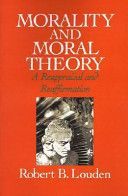
Contemporary philosophers have grown increasingly skeptical toward both morality and moral theory. Some argue that moral theory is a radically misguided enterprise that does not illuminate moral practice, while others simply deny the value of morality in human life. In this important new book, Louden responds to the arguments of both “anti-morality” and “anti-theory” skeptics. In Part One, he develops and defends an alternative conception of morality, which, he argues, captures more of the central features of both Aristotelian and Kantian ethics than do other contemporary models, and enables the central importance of morality to be convincingly reaffirmed. In Louden’s model, morality is primarily a matter of what one does to oneself, rather than what one does or does not do to others. This model eliminates the gulf that many anti-morality critics say exists between morality’s demands and the personal point of view. Louden further argues that morality’s primary focus should be on agents and their lives, rather than on right actions, and that it is always better to be morally better–i.e. it is impossible to be “too moral.” Part Two presents Louden’s alternative conception of moral theory. Here again he draws on the work of Aristotle and Kant, showing that their moral theories have far more in common than is usually thought, and that those features that they share can be the basis for a viable moral theory that is immune to the standard anti-theory objections. Louden reaffirms the necessity and importance of moral theory in human life, and shows that moral theories fulfill a variety of genuine and indispensable human needs.
Information technology is an integral part of the practices and institutions of post-industrial society. It is also a source of hard moral questions and thus is both a probing and relevant area for moral theory. In this volume, an international team of philosophers sheds light on many of the ethical issues arising from information technology, including informational privacy, digital divide and equal access, e-trust and tele-democracy. Collectively, these essays demonstrate how accounts of equality and justice, property and privacy benefit from taking into account how information technology has shaped our social and epistemic practices and our moral experiences. Information technology changes the way that we look at the world and deal with one another. It calls, therefore, for a re-examination of notions such as friendship, care, commitment and trust.
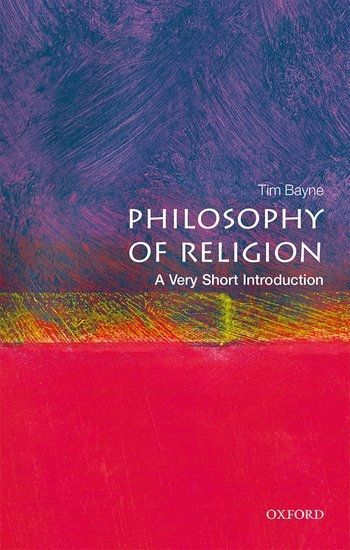
What is the philosophy of religion? How can we distinguish it from theology on the one hand and the psychology/sociology of religious belief on the other? What does it mean to describe God as ‘eternal’? And should religious people want there to be good arguments for the existence of God, or is religious belief only authentic in the absence of these good arguments?00In this ‘Very Short Introduction’ Tim Bayne introduces the field of philosophy of religion, and engages with some of the most burning questions that philosophers discuss. Considering how ‘religion’ should be defined, and whether we even need to be able to define it in order to engage in the philosophy of religion, he goes on to discuss whether the existence of God matters. Exploring the problem of evil, Bayne also debates the connection between faith and reason, and the related question of what role reason should play in religious contexts. Shedding light on the relationship between science and religion, Bayne finishes by considering the topics of reincarnation and the afterlife.
A new investigation into how the advent of precision-guided munitions affects the likelihood of US policy makers to use force. As such, this is an inquiry into the impact of ethics, strategy and military technology on the decision calculus of national leaders. Following the first Gulf War in 1991, this new study shows how US Presidents increasingly used stand-off precision guided munitions (or “PGMs,” especially the Tomahawk cruise missile) either to influence foreign adversaries to make specific policy choices or to signal displeasure with their actions. Such uses of force are attractive because they can lead to desirable policy outcomes where conventional diplomacy has failed but without the large cost of lives, economic resources, or political capital that result from large-scale military operations. In a post-9/11 world, understanding alternative uses of force under significant policy constraints is still of supreme importance.
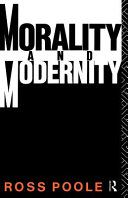
Ross Poole displays the social content of the various conceptions of morality at work in contemporary society, and casts a strikingly fresh light on such fundamental problems as the place of reason in ethics, moral objectivity and the distinction between duty and virtue. The book provides a critical account of the moral theories of a number of major philosophers, including Kant, Marx, Nietzsche, Habermas, Rawls, Gewirth and MacIntyre. It also presents a systematic critique of three of the most significant responses to modernity: liberalism, nationalism and nihilism. It takes seriously the suggestion that men and women are subject to different conceptions of morality, and places the issue of gender at the centre of moral philosophy.
ما از اخلاق چه انتظاری داریم؟ این سوال شاید تاحدودی برای عموم مردم و یا متخصصان این رشته قابل پاسخ باشد؛ اینکه خوب بودن را به ما بیاموزد و در تنظیم روابط فردی م...

جشن کتاب تهران به ایستگاه سی و یکم رسیده است. حال و احوال نشر کتاب خوب نیست و باید فرهنگدوستان را به خرید و هدیه دادن کتاب ترغیب نمود. خانه اخلاقپژوهان جوان ب...

بنیاد کتابهای اخلاق اسلامی عمدتا پالایش جان از آلودگیها و آراستن آن به زیباییها است. اندیشه محوری این قبیل کتابها آن است که انسان فعلی آنی نیست که باید باشد...

-
0 Comments