Notice: تابع WP_Block_Type_Registry::register به طورنادرست فراخوانی شد. نامهای نوع بلوک نباید حروف بزرگ داشته باشند. لطفاً برای اطلاعات بیشتر، اشکال زدایی در وردپرس را مشاهده کنید. (این پیام در نگارش 5.0.0 افزوده شده است.) in /home/ethicsho/public_html/wp-includes/functions.php on line 5313
Warning: Use of undefined constant TDC_PATH_LEGACY - assumed 'TDC_PATH_LEGACY' (this will throw an Error in a future version of PHP) in /home/ethicsho/public_html/wp-content/plugins/td-composer/td-composer.php on line 109
Warning: Use of undefined constant TDSP_THEME_PATH - assumed 'TDSP_THEME_PATH' (this will throw an Error in a future version of PHP) in /home/ethicsho/public_html/wp-content/plugins/td-composer/td-composer.php on line 113 بایگانیهای 401.43 - خانه اخلاق پژوهان جوان Notice: Trying to access array offset on value of type bool in /home/ethicsho/public_html/wp-content/plugins/wp-ulike/inc/general-functions.php on line 807
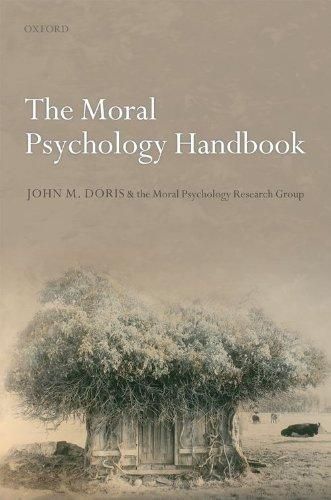
The Moral Psychology Handbook offers a survey of contemporary moral psychology, integrating evidence and argument from philosophy and the human sciences. The chapters cover major issues in moral psychology, including moral reasoning, character, moral emotion, positive psychology, moral rules, the neural correlates of ethical judgment, and the attribution of moral responsibility. Each chapter is a collaborative effort, written jointly by leading researchers in thefield.
Explores aspects of responsibility, including moral accountability; hierarchy, rationality, and the real self; and ethical responsibility and alternative possibilities.
Moral claims not only assume to be true, but they also guide our choices. This fascinating book presents a new theory of normative judgment, the “standard-based theory,” which offers a schematic account of the truth conditions of normative propositions of all kinds, including moral propositions and propositions about reasons. Here, David Copp argues that because any society needs a social moral code in order to enable its members to live together successfully, and because it would be rational for a society to choose such a system, certain moral codes–and the standards they include–are justified. In this work, Copp raises a number of important issues in moral theory, as well as in metaphysics and the philosophy of language.
When does a person qualify for protected and continuing life? At a time when technology can sustain marginal life, it is ever more important to understand what constitutes a person. What are the medical, ethical, mental, legal, and philosophical criteria that determine protectable human life? By providing a much-needed religious/philosophical context for the discussion – examining contemporary thinking on just what constitutes valuable life – Walters broadens his inquiry beyond the human to include other animals and also deals with the phenomenon of anencephalic infants, those who are born without higher brains. Searching for a measurable and humane standard of personhood, Walters looks at its current definition and declares it inadequate. He offers instead the idea of proximate personhood, with criteria for helping to determine which individuals possess a unique claim to life.
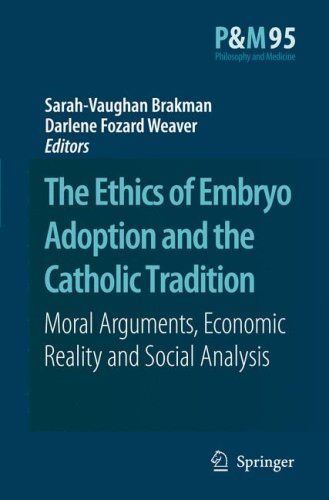
At last, a comprehensive collection of essays that examines and advances ethical evaluations of the controversial and increasingly popular practice of embryo adoption. In the United States alone, 400,000 frozen embryos created for in vitro fertilization exist but are no longer desired for that purpose. What are we morally obliged or permitted to do about these “spare” embryos? More of their genetic parents are considering donating these embryos to others to gestate and raise. This practice is politically volatile (figuring in debates about embryonic stem cells) and medically and morally complex. At the present time within the Roman Catholic Church there is no official teaching on embryo adoption. Catholic ethical analyses grapple with the way embryo adoption comports with respect for embryonic human life yet challenges Catholic moral critiques of assisted reproductive technologies. This volume is the first to bring together leading philosophers and theologians to engage Catholic debates about embryo adoption in an interactive format. The editors, a philosopher bioethicist and a moral theologian, provide a helpful overview of the practice and the arguments surrounding embryo adoption. They engage neglected Catholic ethical resources and issues to advance the current debate and chart new directions in Catholic moral thinking about this intriguing practice. The volume also includes a description of embryo adoption from a physician practitioner along with reflections from a couple who successfully adopted an embryo.
ما از اخلاق چه انتظاری داریم؟ این سوال شاید تاحدودی برای عموم مردم و یا متخصصان این رشته قابل پاسخ باشد؛ اینکه خوب بودن را به ما بیاموزد و در تنظیم روابط فردی م...

جشن کتاب تهران به ایستگاه سی و یکم رسیده است. حال و احوال نشر کتاب خوب نیست و باید فرهنگدوستان را به خرید و هدیه دادن کتاب ترغیب نمود. خانه اخلاقپژوهان جوان ب...

بنیاد کتابهای اخلاق اسلامی عمدتا پالایش جان از آلودگیها و آراستن آن به زیباییها است. اندیشه محوری این قبیل کتابها آن است که انسان فعلی آنی نیست که باید باشد...

-
0 Comments