Notice: تابع WP_Block_Type_Registry::register به طورنادرست فراخوانی شد. نامهای نوع بلوک نباید حروف بزرگ داشته باشند. لطفاً برای اطلاعات بیشتر، اشکال زدایی در وردپرس را مشاهده کنید. (این پیام در نگارش 5.0.0 افزوده شده است.) in /home/ethicsho/public_html/wp-includes/functions.php on line 5313
Warning: Use of undefined constant TDC_PATH_LEGACY - assumed 'TDC_PATH_LEGACY' (this will throw an Error in a future version of PHP) in /home/ethicsho/public_html/wp-content/plugins/td-composer/td-composer.php on line 109
Warning: Use of undefined constant TDSP_THEME_PATH - assumed 'TDSP_THEME_PATH' (this will throw an Error in a future version of PHP) in /home/ethicsho/public_html/wp-content/plugins/td-composer/td-composer.php on line 113 بایگانیهای 364.601 - خانه اخلاق پژوهان جوان Notice: Trying to access array offset on value of type bool in /home/ethicsho/public_html/wp-content/plugins/wp-ulike/inc/general-functions.php on line 807
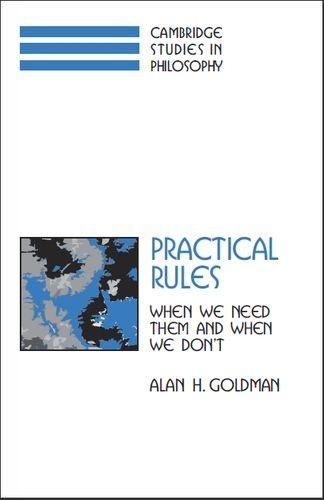
Rules proliferate; some are kept with a bureaucratic stringency bordering on the absurd, while others are manipulated and ignored in ways that injure our sense of justice. Under what conditions should we make exceptions to rules, and when should they be followed despite particular circumstances? The two dominant models in the current literature on rules are the particularist account and that which sees the application of rules as normative. Taking a position that falls between these two extremes, Alan Goldman is the first to provide a systematic framework to clarify when we need to follow rules in our moral, legal, and prudential decisions, and when we ought not to do so.
Truth — Meaning — Reality presents a fresh approach to philosophy: a broad and unified deflationism that encompasses language, thought, knowledge, reality, and the relations between them. Horwich’s story begins with a minimalist view of truth according to which this extraordinary concept is far less profound and substantial than has usually been assumed, since it stems entirely from our regarding “It is true that dogs bark” as equivalent to “Dogs bark,” and similarly in the case of all other statements. There’s nothing more to truth than that! This view turns out to be of fundamental importance throughout the subject. In the first instance it paves the way to an account of meaning as use, whereby the sense of each word-type is given by its basic patterns of deployment rather than by its association with a feature of the non-linguistic world. And the combination of deflated truth and ‘meaning as use’ then yields a perspective from which the long-standing debates between forms of “realism” and “anti-realism” must be preconceived. We are able to see that the positions typically adopted in these debates are all defective — contrived products of the mistaken assumption that reality, together with our representation of it, must exhibit a rigid uniformity and that deviations from the norm would be intolerably “weird.” The fourteen essays collected here constitute a coherent and complete expression of this three-pronged philosophy. Each of them is self-standing. But they have been revised and arranged so as to reveal the power and plausibility of Horwich’s overall approach. is three-pronged philosophy.
Issues of global justice dominate our contemporary world. Incre- ingly, philosophers are turning their attention to thinking about particular issues of global justice and the accounts that would best facilitate theorizing about these. This volume of papers on global justice derives from a mini-conference held in conjunction with the Paci?c Division meeting of the American Philosophical Association in Pasadena, California, in 2004. The idea of holding a mini-c- ference on global justice was inspired by the growth of interest in such questions, and it was hoped that organizing the mini-conference 1 would stimulate further good writing in this area. We believe that our mission has been accomplished! We received a number of thoughtful papers on both theoretical and more applied issues, showing excellent coverage of a range of topics in the domain of global justice. A selection of some of the very best papers is published in this special issue of The Journal of Ethics. In particular, we tried to include papers that would re?ect some of the range of topics that were covered at the conference, to give readers a sense of both the scope of the ?eld as it is currently emerging and the direction that the debates seem to be taking. As a result of increased attention to theorizing about global j- tice, cosmopolitanism has enjoyed a resurgence of interest as well.
How good companies build a culture of integrity In the present environment of corporate governance brought on by high-profile executive scandals, this book makes a strong case for encouraging business leaders to manage beyond compliance. Achieving the bare minimum of compliance isn’t enough. By making corporate responsibility and integrity a strategic priority-rather than something companies are forced to comply with-companies can realize tangible financial returns and benefits. This book provides practical advice, effective tools, and time-tested best practices for approaching corporate integrity strategically and managing an integrity program on a day-to-day basis. There is a growing realization that compliance with the rules is only a minimum standard of performance, and an increasing demand from stakeholders at every level — shareholders, employees, customers along the entire supply chain, consumers, advocacy groups, and the local community at large — for more transparency and accountability from corporations. But most businesses have little experience and few tools to deal with the urgent demand to increase corporate responsibility. Corporate Integrity provides practical tools and proven processes to manage complex integrity dilemmas and support implementation: Explains how to create a culture of integrity in your organization and how to motivate the appropriate corporate behaviors. Coverage includes: How to assess and measure integrity; how to align corporate integrity commitments and actions; how to design and implement dependable and strategic corporate accountability systems and processes; how to develop corporate integrity standards and report on them, and much more. Includes a wealth of practical business tools and best practices that readers can apply to improve the level of corporate integrity in their own company. Features three detailed case studies and numerous other examples that illustrate corporate integrity dilemmas and solutions in action. Shows how managing corporate responsibility strategically and proactively can go beyond a mere public relations exercise to foster a corporate “win” in the court of popular opinion and in the marketplace. Bridges the gaps between corporations, governments, employees, interest groups, and consumers. Offers tools and solutions that apply to both for-profit corporations and non-profit organizations.
ما از اخلاق چه انتظاری داریم؟ این سوال شاید تاحدودی برای عموم مردم و یا متخصصان این رشته قابل پاسخ باشد؛ اینکه خوب بودن را به ما بیاموزد و در تنظیم روابط فردی م...

جشن کتاب تهران به ایستگاه سی و یکم رسیده است. حال و احوال نشر کتاب خوب نیست و باید فرهنگدوستان را به خرید و هدیه دادن کتاب ترغیب نمود. خانه اخلاقپژوهان جوان ب...

بنیاد کتابهای اخلاق اسلامی عمدتا پالایش جان از آلودگیها و آراستن آن به زیباییها است. اندیشه محوری این قبیل کتابها آن است که انسان فعلی آنی نیست که باید باشد...

-
0 Comments