Notice: تابع WP_Block_Type_Registry::register به طورنادرست فراخوانی شد. نامهای نوع بلوک نباید حروف بزرگ داشته باشند. لطفاً برای اطلاعات بیشتر، اشکال زدایی در وردپرس را مشاهده کنید. (این پیام در نگارش 5.0.0 افزوده شده است.) in /home/ethicsho/public_html/wp-includes/functions.php on line 5313
Warning: Use of undefined constant TDC_PATH_LEGACY - assumed 'TDC_PATH_LEGACY' (this will throw an Error in a future version of PHP) in /home/ethicsho/public_html/wp-content/plugins/td-composer/td-composer.php on line 109
Warning: Use of undefined constant TDSP_THEME_PATH - assumed 'TDSP_THEME_PATH' (this will throw an Error in a future version of PHP) in /home/ethicsho/public_html/wp-content/plugins/td-composer/td-composer.php on line 113 بایگانیهای 174.20973 - خانه اخلاق پژوهان جوان Notice: Trying to access array offset on value of type bool in /home/ethicsho/public_html/wp-content/plugins/wp-ulike/inc/general-functions.php on line 807
Written across the disciplines of art history, literature, philosophy, sociology, and theology, the ten essays comprising the collection all insist on multidimensional definitions of evil.Taking its title from a moment in Shakespeare’s Tempest when Prospero acknowledges his responsibility for Caliban, this collection explores the necessarily ambivalent relationship between humanity and evil. To what extent are a given society’s definitions of evil self-serving? Which figures are marginalized in the process of identifying evil? How is humanity itself implicated in the production of evil? Is evil itself something fundamentally human? These questions, indicative of the kinds of issues raised in this collection, seem all the more pressing in light of recent world events.The ten essays were originally presented at the First Global Conference on Perspectives on Evil and Human Wickedness, held in March 2000, in Lady Margaret Hall, Oxford University.At the Interface/Probing the Boundaries seeks to encourage and promote cutting edge inter-disciplinary and multi-disciplinary projects and inquiry. By bringing people together from differing contexts, disciplines, professions, and vocations, the aim is to engage in conversations that are innovative, imaginative, and creatively interactive.Inter-Disciplinary dialogue enables people to go beyond the boundaries of what they usually encounter and share in perspectives that are new, challenging, and richly rewarding. This kind of dialogue often illuminates one’s own area of work, is suggestive of new possibilities for development, and creates exciting horizons for future conversations with persons from a wide variety of national and international settings.By sharing cross-disciplinary insights and perspectives, ATI/PTB publications are designed to be both exploratory examinations of particular areas and issues, and rigorous inquiries into specific subjects. Books in the series are enabling resources which will encourage sustained and creative dialogue, and become the future resource for further inquiries and research.
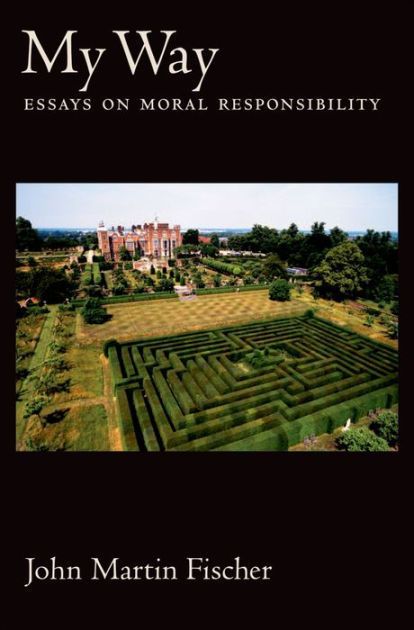
This is a selection of essays on moral responsibility that represent the major components of John Martin Fischer’s overall approach to freedom of the will and moral responsibility. The collection exhibits the overall structure of Fischer’s view and shows how the various elements fit together to form a comprehensive framework for analyzing free will and moral responsibility. The topics include deliberation and practical reasoning, freedom of the will, freedom of action, various notions of control, and moral accountability. The essays seek to provide a foundation for our practices of holding each other (and ourselves) morally and legally accountable for our behavior. A crucial move is the distinction between two kinds of control. According to Fischer, “regulative control” involves freedom to choose and do otherwise (“alternative possibilities”), whereas “guidance control” does not. Fischer contends that guidance control is all the freedom we need to be morally responsible agents. Further, he contends that such control is fully compatible with causal determinism. Additionally, Fischer argues that we do not need genuine access to alternative possibilities in order for there to be a legitimate point to practical reasoning. Fischer’s overall framework contains an argument for the contention that guidance control, and not regulative control, is associated with moral responsibility, a sketch of a comprehensive theory of moral responsibility (that ties together responsibility for actions, omissions, consequences, and character), and an account of the value of moral responsibility. On this account, the value of exhibiting freedom (of the relevant sort) and thus being morally responsible for one’s behavior is a species of the value of artistic self-expression.
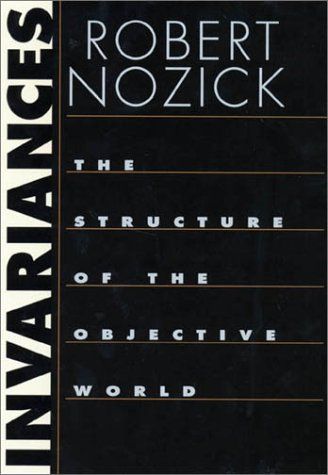
Excerpts from Robert Nozick’s “Invariances” Necessary truths are invariant across all possible worlds, contingent ones across only some. No wonder necessity lures philosophers. It is the flame, the philosopher the moth. Our intuitions that certain statements are necessary do not powerfully support this claim when natural selection would produce strong intuitions of their self-evidence, even were these statements (only) contingently true. Contemporary philosophers who give great weight to intuitions need to offer some account of why such intuitions are reliable and are to be trusted. Of course, if the purpose of such philosophy is merely to codify and systematize the intuitions that (for whatever reason) are held, then a philosophy built upon intuitions will need no further basis. And it will have no further validity. You might think that an insight into metaphysical impossibility could save the physicists much useless work by thereby excluding something as physically possible. Things seem to have worked in the opposite direction, though. Driven by a need to explain strange data, physicists formulate theories that countenance what previously was held to be metaphysically impossible. . . The physical tail wags the metaphysical dog. Why is there an objective world? Within evolutionary cosmology scientific laws might be viewed as the heritable structure of a universe, akin to what in biology would be an organism’s genetic endowment. . . Suppose that the reproductive process of a universe produces transformed offspring universes that differ from their parent. The greater the transformations that a law is invariant under, and the wider their number, the greater is that law’s heritability. The vast majority of the universes that exist through the processes of evolutionary cosmology, therefore, will exhibit laws that are invariant under a wide range of significant transformations. Such invariance, we have seen, is exactly what constitutes objectiveness. Evolutionary cosmology gives us objective worlds.
This is the most up-to-date, brief and accessible introduction to Kants ethics available. It approaches the moral theory via the political philosophy, thus allowing the reader to appreciate why Kant argued that the legal structure for any civil society must have a moral basis. This approach also explains why Kant thought that our basic moral norms should serve as laws of conduct for everyone. The volume includes a detailed commentary on Foundations of the Metaphysics of Morals, Kants most widely studied work of moral philosophy. The book complements the authors much more comprehensive and systematic study Immanuel Kants Moral Theory (Cambridge, 1989), a volume that has received the highest critical praise. With its briefer compass and non-technical style this new introduction should help to disseminate the key elements of one of the great modern philosophies to an even wider readership.
ما از اخلاق چه انتظاری داریم؟ این سوال شاید تاحدودی برای عموم مردم و یا متخصصان این رشته قابل پاسخ باشد؛ اینکه خوب بودن را به ما بیاموزد و در تنظیم روابط فردی م...

جشن کتاب تهران به ایستگاه سی و یکم رسیده است. حال و احوال نشر کتاب خوب نیست و باید فرهنگدوستان را به خرید و هدیه دادن کتاب ترغیب نمود. خانه اخلاقپژوهان جوان ب...

بنیاد کتابهای اخلاق اسلامی عمدتا پالایش جان از آلودگیها و آراستن آن به زیباییها است. اندیشه محوری این قبیل کتابها آن است که انسان فعلی آنی نیست که باید باشد...

-
0 Comments