Notice: تابع WP_Block_Type_Registry::register به طورنادرست فراخوانی شد. نامهای نوع بلوک نباید حروف بزرگ داشته باشند. لطفاً برای اطلاعات بیشتر، اشکال زدایی در وردپرس را مشاهده کنید. (این پیام در نگارش 5.0.0 افزوده شده است.) in /home/ethicsho/public_html/wp-includes/functions.php on line 5313
Warning: Use of undefined constant TDC_PATH_LEGACY - assumed 'TDC_PATH_LEGACY' (this will throw an Error in a future version of PHP) in /home/ethicsho/public_html/wp-content/plugins/td-composer/td-composer.php on line 109
Warning: Use of undefined constant TDSP_THEME_PATH - assumed 'TDSP_THEME_PATH' (this will throw an Error in a future version of PHP) in /home/ethicsho/public_html/wp-content/plugins/td-composer/td-composer.php on line 113 بایگانیهای William Rehg - خانه اخلاق پژوهان جوان Notice: Trying to access array offset on value of type bool in /home/ethicsho/public_html/wp-content/plugins/wp-ulike/inc/general-functions.php on line 807
This introduction to ethics judiciously combines moral theory with applied ethics to give an opportunity for students to develop acute thinking About Ethical Matters.; The Author Begins Motivating A Concern For moral discourse by dispelling often met objections over relativism and subjectivity. interweaving normative and meta-ethical considerations, a convincing modern account of moral thinking emerges.; Moral theories – consequentialism, Kantianism, contractualism – are explained and illustrated in a way that holds the reader’s attention, and students of ethics will take away a perceptive and practical understanding of the nature of moral reasoning and an ability, on such matters, to think afresh for themselves.
The position of rational egoism centres upon the thought that the rational thing to do must be to pursue one’s own self-interest. Focusing on the work of Hobbes and Sidgwick, this book is an extensive history and evaluation of rational egoism. They are, after the ancients, the foremost exponents of rational egoism. He also considers other figures – Grotius, Samuel Clarke, John Clarke, Butler, Hume, Reid, Kant, Paley and Bentham – and a related position: the instrumental theory of rationality. Robert Shaver’s conclusion is that none of the arguments for rational egoism or the instrumental theory are cogent. This is an important book not just for historians of philosophy but for all readers in philosophy or the social sciences interested in theories of morality and rationality.
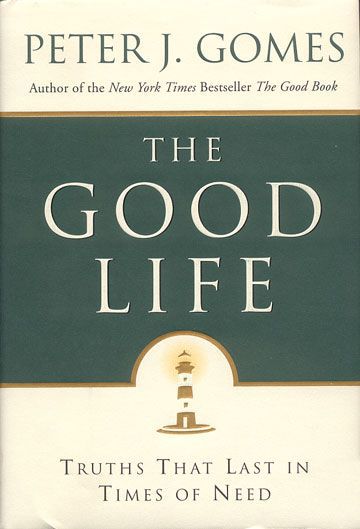
Urges readers to adopt deeper truths and more significant values, and challenges the allure of wealth and power, blind faith in science, and the desire for success, freedom, immortality, and personal happiness.
Bonnie Steinbock presents The Oxford Handbook of Bioethics –an authoritative, state-of-the-art guide to current issues in bioethics. Thirty-four contributors reflect the interdisciplinarity that is characteristic of bioethics, and its increasingly international character. Thirty topics are covered in original essays written by some of the world’s leading figures in the field, as well as by some newer “up-and-comers.” The essays address both perennial issues, such as the methodology of bioethics, autonomy, justice, death, and moral status, and newer issues, such as biobanking, stem cell research, cloning, pharmacogenomics, and bioterrorism. Other topics concern mental illness and moral agency, the rule of double effect, justice and the elderly, the definition of death, organ transplantation, feminist approaches to commodification of the body, life extension, advance directives, physician-assisted death, abortion, genetic research, population screening, enhancement, research ethics, and the implications of public and global health for bioethics. Anyone who wants to know how the central debates in bioethics have developed in recent years, and where the debates are going, will want to consult this book. It will be an invaluable resource not only for scholars and graduate students in bioethics, but also for those in philosophy, medicine, law, theology, social science, public policy, and public health who wish to keep abreast of developments in bioethics.
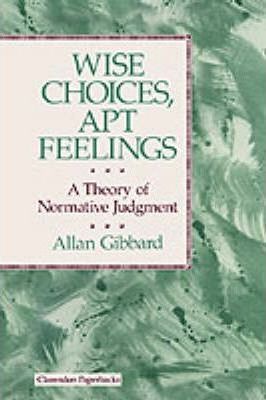
‘Choices can be wise or foolish, and feelings can be apt or off the mark.’ Since this is how we judge, it would be good to know what content these normative judgements carry. Gibbard offers an answer, and elaborates it. His theory explores what is at issue in narrowly moral questions, and in questions of rational thought and conduct in general. It helps to explain why normative thought and talk so pervade human life, and why our highly social species might have evolved to be gripped by these questions. Gibbard asks how, if his theory is right, we can interpret our normative puzzles, and thus proceed toward finding answers to them. Not available from OUP in the USA, Canada, Japan or the Phillippines.
ما از اخلاق چه انتظاری داریم؟ این سوال شاید تاحدودی برای عموم مردم و یا متخصصان این رشته قابل پاسخ باشد؛ اینکه خوب بودن را به ما بیاموزد و در تنظیم روابط فردی م...

جشن کتاب تهران به ایستگاه سی و یکم رسیده است. حال و احوال نشر کتاب خوب نیست و باید فرهنگدوستان را به خرید و هدیه دادن کتاب ترغیب نمود. خانه اخلاقپژوهان جوان ب...

بنیاد کتابهای اخلاق اسلامی عمدتا پالایش جان از آلودگیها و آراستن آن به زیباییها است. اندیشه محوری این قبیل کتابها آن است که انسان فعلی آنی نیست که باید باشد...

-
0 Comments