Notice: تابع WP_Block_Type_Registry::register به طورنادرست فراخوانی شد. نامهای نوع بلوک نباید حروف بزرگ داشته باشند. لطفاً برای اطلاعات بیشتر، اشکال زدایی در وردپرس را مشاهده کنید. (این پیام در نگارش 5.0.0 افزوده شده است.) in /home/ethicsho/public_html/wp-includes/functions.php on line 5313
Warning: Use of undefined constant TDC_PATH_LEGACY - assumed 'TDC_PATH_LEGACY' (this will throw an Error in a future version of PHP) in /home/ethicsho/public_html/wp-content/plugins/td-composer/td-composer.php on line 109
Warning: Use of undefined constant TDSP_THEME_PATH - assumed 'TDSP_THEME_PATH' (this will throw an Error in a future version of PHP) in /home/ethicsho/public_html/wp-content/plugins/td-composer/td-composer.php on line 113 بایگانیهای Viktor Mayer-Schonberger - خانه اخلاق پژوهان جوان Notice: Trying to access array offset on value of type bool in /home/ethicsho/public_html/wp-content/plugins/wp-ulike/inc/general-functions.php on line 807
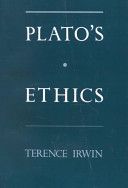
This exceptional book examines and explains Plato’s answer to the normative question, “How ought we to live?” It discusses Plato’s conception of the virtues; his views about the connection between the virtues and happiness; and the account of reason, desire, and motivation that underlies his arguments about the virtues. Plato’s answer to the epistemological question, “How can we know how we ought to live?” is also discussed. His views on knowledge, belief, and inquiry, and his theory of Forms, are examined, insofar as they are relevant to his ethical view. Terence Irwin traces the development of Plato’s moral philosophy, from the Socratic dialogues to its fullest exposition in the Republic. Plato’s Ethics discusses Plato’s reasons for abandoning or modifying some aspects of Socratic ethics, and for believing that he preserves Socrates’ essential insights. A brief and selective discussion of the Statesmen, Philebus, and Laws is included. Replacing Irwin’s earlier Plato’s Moral Theory (Oxford, 1977), this book gives a clearer and fuller account of the main questions and discusses some recent controversies in the interpretation of Plato’s ethics. It does not presuppose any knowledge of Greek or any extensive knowledge of Plato.
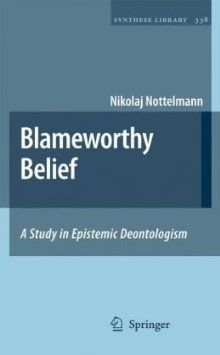
Believing the wrong thing may sometimes have drastic consequences. The question as to when a person is not only ill-guided, but genuinely at fault for holding a particular belief is an important one: It touches upon the roots of our understanding of such notions as criminal negligence and moral responsibility. The answer to this question may influence the extent to which we are willing to submit each other to punishments ranging from mild resentment to harsh prison terms.This book presents an extensive effort to shed light on the conditions under which we may appropriately deem someone blameworthy for holding a particular belief. It regiments and unifies several debates within contemporary epistemology, ethics and legal scholarship. Finally, the book brings a new philosophical look on issues like our power to control beliefs and the extent and nature of foresight. “Blameworthy Belief is unique in being an up-to-date monograph devoted entirely to the problem of a moral appraisal of beliefs and the closely related problem of deciding to believe (doxastic voluntarism and anti-voluntarism). It is bound to become a highly influential work and is of great interest not only to epistemologists, but also to philosophers of law and moral philosophers.” Heinrich Wansing, Professor of Philosophy of Science and Logic, Dresden University of Technology, Germany “Nottelmann has nicely managed to weave accounts of competing views into his discussion, and so this book provides an excellent survey of the literature en route to the development of a sensible account of how we could be said to be responsible for believing various things, even though belief formation is not under our voluntary control.” John Heil, Professor of Philosophy, Washington University in St. Louis, U.S.A., and Monash University, Australia
The idea that religion has a dangerous tendency to promote violence is part of the conventional wisdom of Western societies, and it underlies many of our institutions and policies, from limits on the public role of religion to efforts to promote liberal democracy in the Middle East. William T. Cavanaugh challenges this conventional wisdom by examining how the twin categories of religion and the secular are constructed. A growing body of scholarly work explores how the category ‘religion’ has been constructed in the modern West and in colonial contexts according to specific configurations of political power. Cavanaugh draws on this scholarship to examine how timeless and transcultural categories of ‘religion and ‘the secular’ are used in arguments that religion causes violence. He argues three points: 1) There is no transhistorical and transcultural essence of religion. What counts as religious or secular in any given context is a function of political configurations of power; 2) Such a transhistorical and transcultural concept of religion as non-rational and prone to violence is one of the foundational legitimating myths of Western society; 3) This myth can be and is used to legitimate neo-colonial violence against non-Western others, particularly the Muslim world.
Jason Stanley presents a startling and provocative claim about knowledge: that whether or not someone knows a proposition at a given time is in part determined by his or her practical interests, i.e. by how much is at stake for that person at that time. So whether a true belief is knowledge is not merely a matter of supporting beliefs or reliability; in the case of knowledge, practical rationality and theoretical rationality are intertwined. Stanley defends this thesis against alternative accounts of the phenomena that motivate it, such as the claim that knowledge attributions are linguistically context-sensitive (contextualism about knowledge attributions), and the claim that the truth of a knowledge claim is somehow relative to the person making the claim (relativism about knowledge). In the course of his argument Stanley introduces readers to a number of strategies for resolving philosophical paradox, making the book essential not just for specialists in epistemology but for all philosophers interested in philosophical methodology. Since a number of his strategies appeal to linguistic evidence, it will be of great interest to linguists as well.
ما از اخلاق چه انتظاری داریم؟ این سوال شاید تاحدودی برای عموم مردم و یا متخصصان این رشته قابل پاسخ باشد؛ اینکه خوب بودن را به ما بیاموزد و در تنظیم روابط فردی م...

جشن کتاب تهران به ایستگاه سی و یکم رسیده است. حال و احوال نشر کتاب خوب نیست و باید فرهنگدوستان را به خرید و هدیه دادن کتاب ترغیب نمود. خانه اخلاقپژوهان جوان ب...

بنیاد کتابهای اخلاق اسلامی عمدتا پالایش جان از آلودگیها و آراستن آن به زیباییها است. اندیشه محوری این قبیل کتابها آن است که انسان فعلی آنی نیست که باید باشد...

-
0 Comments