Notice: تابع WP_Block_Type_Registry::register به طورنادرست فراخوانی شد. نامهای نوع بلوک نباید حروف بزرگ داشته باشند. لطفاً برای اطلاعات بیشتر، اشکال زدایی در وردپرس را مشاهده کنید. (این پیام در نگارش 5.0.0 افزوده شده است.) in /home/ethicsho/public_html/wp-includes/functions.php on line 5313
Warning: Use of undefined constant TDC_PATH_LEGACY - assumed 'TDC_PATH_LEGACY' (this will throw an Error in a future version of PHP) in /home/ethicsho/public_html/wp-content/plugins/td-composer/td-composer.php on line 109
Warning: Use of undefined constant TDSP_THEME_PATH - assumed 'TDSP_THEME_PATH' (this will throw an Error in a future version of PHP) in /home/ethicsho/public_html/wp-content/plugins/td-composer/td-composer.php on line 113 بایگانیهای Rebecca A. Martusewicz - خانه اخلاق پژوهان جوان Notice: Trying to access array offset on value of type bool in /home/ethicsho/public_html/wp-content/plugins/wp-ulike/inc/general-functions.php on line 807
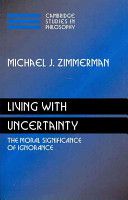
Every choice we make is set against a background of massive ignorance about our past, our future, our circumstances, and ourselves. Philosophers are divided on the moral significance of such ignorance. Some say that it has a direct impact on how we ought to behave – the question of what our moral obligations are; others deny this, claiming that it only affects how we ought to be judged in light of the behaviour in which we choose to engage – the question of what responsibility we bear for our choices. Michael Zimmerman claims that our ignorance has an important bearing on both questions, and offers an account of moral obligation and moral responsibility that is sharply at odds with the prevailing wisdom. His book will be of interest to a wide range of readers in ethics.
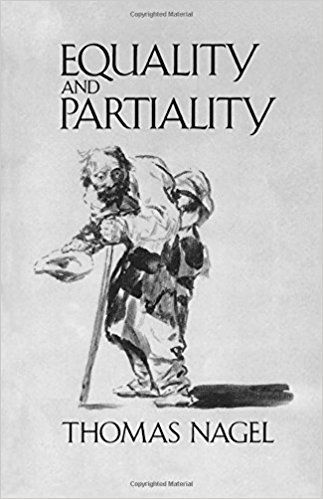
Derived from Thomas Nagel’s Locke Lectures, Equality and Partiality proposes a nonutopian account of political legitimacy, based on the need to accommodate both personal and impersonal motives in any credible moral theory, and therefore in any political theory with a moral foundation. Within each individual, Nagel believes, there is a division between two standpoints, the personal and the impersonal. Without the impersonal standpoint, there would be no morality, only the clash, compromise, and occasional convergence of individual perspectives. It is because a human being does not occupy only his own point of view that each of us is susceptible to the claims of others through private and public morality. Political systems, to be legitimate, must achieve an integration of these two standpoints within the individual. These ideas are applied to specific problems such as social and economic inequality, toleration, international justice, and the public support of culture. Nagel points to the problem of balancing equality and partiality as the most important issue with which political theorists are now faced.
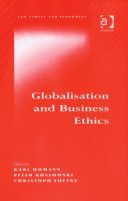
Offers an extensive and probing ethical analysis of economic globalisation. This innovative and highly informative book on globalisation and business ethics will set the tone for the debate on this important issue in the coming years, and will be an invaluable source of information for everyone committed to the global economic responsibilities of businesses and governments. Ron Jeurissen, Professor of business ethics, Nyenrode Business Universiteit/ European Institute for Business Ethics, The Netherlands This volume takes an interdisciplinary approach to provide a theoretical overview of how business ethics deals with the phenomenon of globalization. The authors first examine the origins and development of globalization and its interaction with business ethics, before discussing the impact on and role of national and multinational corporations. The book goes on to examine the relationship between industrialized and developing countries, and explores the place of ethics in globalized markets. Contents: Introduction; Part I Globalisation: Concepts and Problems: Globalisation from a business ethics point of view, Karl Homann; Concepts of globalisation: the institutional prerequisites for the integration of world markets, Michael Ehret, Michaela Haase and Martin Kaluza; Diagnoses of our time: theoretical approaches to the globalised age, Manfred Prisching; Globalisation as a gendered process: a differentiated survey on feminist and postcolonial perspectives, Silvia Bauer and Tatjana Schönwälder- Kuntze. Part II Globalisation, Business and Corporate Governance: Globalisation of corporate governance, Klaus J. Hopt; Business ethics in globalised financial markets, Peter Koslowki; Transparency and integrity: contrary concepts?, Frits Schipper; Tangible ethics: commitments in business organisations, Eberhard Schnebel and Margo A. Bienert. Part III Global Justice: A theory of global justice focussing on absolute poverty, Elke Mack; Just relations between North and South in international financial markets, Bernhard Emunds; Access to essential medicines: global justice beyond equality, Georg Marckmann and Matthis Synofzik. Part IV Globalisation, Philosophy and Culture: Social glue under conditions of globalisation: philosophers on essential normative resources, Christopher Lütge; Sovereignty of interpretation: a dubious model of cultural globalisation, Michael Neuner; Index. About the Author: Karl Homann is Professor and Chair for Philosophy and Economics at the University of Munich, Germany. Peter Koslowski is Professor of Philosophy, especially Philosophy of Management and Organizations and History of Philosophy, at the Free University Amsterdam, The Netherlands. Christoph Luetge is Assistant Professor in the Department of Philosophy, and Chair for Philosophy and Economics at the University of Munich, Germany.
Courtney Jung traces the development of indigenous movements in Mexico, linking indigenous identity directly to the project of Mexican state formation. She argues that the moral force of indigenous claims rests on the history of oppression that has constituted the indigenous as a political group, and not on cultural difference.
ما از اخلاق چه انتظاری داریم؟ این سوال شاید تاحدودی برای عموم مردم و یا متخصصان این رشته قابل پاسخ باشد؛ اینکه خوب بودن را به ما بیاموزد و در تنظیم روابط فردی م...

جشن کتاب تهران به ایستگاه سی و یکم رسیده است. حال و احوال نشر کتاب خوب نیست و باید فرهنگدوستان را به خرید و هدیه دادن کتاب ترغیب نمود. خانه اخلاقپژوهان جوان ب...

بنیاد کتابهای اخلاق اسلامی عمدتا پالایش جان از آلودگیها و آراستن آن به زیباییها است. اندیشه محوری این قبیل کتابها آن است که انسان فعلی آنی نیست که باید باشد...

-
0 Comments