Notice: تابع WP_Block_Type_Registry::register به طورنادرست فراخوانی شد. نامهای نوع بلوک نباید حروف بزرگ داشته باشند. لطفاً برای اطلاعات بیشتر، اشکال زدایی در وردپرس را مشاهده کنید. (این پیام در نگارش 5.0.0 افزوده شده است.) in /home/ethicsho/public_html/wp-includes/functions.php on line 5313
Warning: Use of undefined constant TDC_PATH_LEGACY - assumed 'TDC_PATH_LEGACY' (this will throw an Error in a future version of PHP) in /home/ethicsho/public_html/wp-content/plugins/td-composer/td-composer.php on line 109
Warning: Use of undefined constant TDSP_THEME_PATH - assumed 'TDSP_THEME_PATH' (this will throw an Error in a future version of PHP) in /home/ethicsho/public_html/wp-content/plugins/td-composer/td-composer.php on line 113 بایگانیهای Philip Blosser - خانه اخلاق پژوهان جوان Notice: Trying to access array offset on value of type bool in /home/ethicsho/public_html/wp-content/plugins/wp-ulike/inc/general-functions.php on line 807
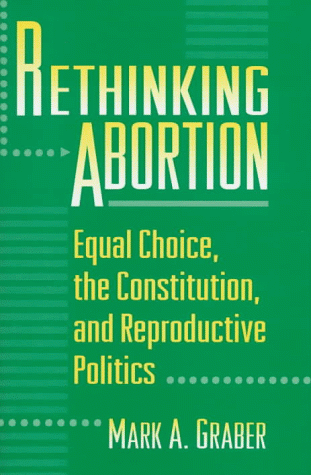
Mark Graber looks at the history of abortion law in action to argue that the only defensible, constitutional approach to the issue is to afford all women equal choice – abortion should remain legal or bans should be strictly enforced. Steering away from metaphysical critiques of privacy, Graber compares the philosophical, constitutional, and democratic merits of the two systems of abortion regulation witnessed in the twentieth-century: pre-Roe v. Wade statutory prohibitions on abortion and Roe’s ban on significant state interference with the market for safe abortion services. He demonstrates that before Roe, pro-life measures were selectively and erratically administered, thereby subverting our constitutional commitment to equal justice. Claiming that these measures would be similarly administered if reinstated, the author seeks to increase support for keeping abortion legal, even among those who have reservations about its morality. Abortion should remain legal, Graber argues, because statutory bans on abortion have a history of being enforced in ways that intentionally discriminate against poor persons and persons of color. In the years before Roe, the same law enforcement officials who routinely ignored and sometimes assisted those physicians seeking to terminate pregnancies for their private patients too often prevented competent abortionists from offering the same services to the general public. This double standard violated the fundamental human and constitutional right of equal justice under law, a right that has powerful roots in the American political tradition and that remains a major concern of the equal protection clause of the Fourteenth Amendment.
This book is the first broad history of the growing field of bioethics. Covering the period 1947-1987, it examines the origin and evolution of the debates over human experimentation, genetic engineering, organ transplantation, termination of life-sustaining treatment, and new reproductivetechnologies. It assesses the contributions of philosophy, theology, law and the social sciences to the expanding discourse of bioethics. Written by one of the field’s founders, it is based on extensive archival research into resources that are difficult to obtain and on interviews with manyleading figures. A very readable account of the development of bioethics, the book stresses the history of ideas but does not neglect the social and cultural context and the people involved.
Intellectual property (IP) is a crucial contributor to economic growth and competitiveness within the EU. This book offers a compact and accessible account of EU intellectual property law and policy, covering copyright, patents, designs, trademarks and the enforcement of rights. The author also addresses aspects of the free movement of goods and services, competition law, customs measures and anti-counterfeiting efforts. Setting EU intellectual property law in its wider international context, this work reveals the framework within which the national IP laws of member states operate. The book seeks to highlight the most important policy issues and arguments of relevance to the EU, both within the Union, and in its relations with the rest of the world. With its the detailed references, cross-referencing and suggestions for further readings, EU Intellectual Property Law and Policy is essential reading for postgraduate students and academic lawyers in IP and EU law. Practitioners seeking a broad account of the area will also appreciate this important contribution.
ما از اخلاق چه انتظاری داریم؟ این سوال شاید تاحدودی برای عموم مردم و یا متخصصان این رشته قابل پاسخ باشد؛ اینکه خوب بودن را به ما بیاموزد و در تنظیم روابط فردی م...

جشن کتاب تهران به ایستگاه سی و یکم رسیده است. حال و احوال نشر کتاب خوب نیست و باید فرهنگدوستان را به خرید و هدیه دادن کتاب ترغیب نمود. خانه اخلاقپژوهان جوان ب...

بنیاد کتابهای اخلاق اسلامی عمدتا پالایش جان از آلودگیها و آراستن آن به زیباییها است. اندیشه محوری این قبیل کتابها آن است که انسان فعلی آنی نیست که باید باشد...

-
0 Comments