Notice: تابع WP_Block_Type_Registry::register به طورنادرست فراخوانی شد. نامهای نوع بلوک نباید حروف بزرگ داشته باشند. لطفاً برای اطلاعات بیشتر، اشکال زدایی در وردپرس را مشاهده کنید. (این پیام در نگارش 5.0.0 افزوده شده است.) in /home/ethicsho/public_html/wp-includes/functions.php on line 5313
Warning: Use of undefined constant TDC_PATH_LEGACY - assumed 'TDC_PATH_LEGACY' (this will throw an Error in a future version of PHP) in /home/ethicsho/public_html/wp-content/plugins/td-composer/td-composer.php on line 109
Warning: Use of undefined constant TDSP_THEME_PATH - assumed 'TDSP_THEME_PATH' (this will throw an Error in a future version of PHP) in /home/ethicsho/public_html/wp-content/plugins/td-composer/td-composer.php on line 113 بایگانیهای Lenn E. Goodman - خانه اخلاق پژوهان جوان Notice: Trying to access array offset on value of type bool in /home/ethicsho/public_html/wp-content/plugins/wp-ulike/inc/general-functions.php on line 807
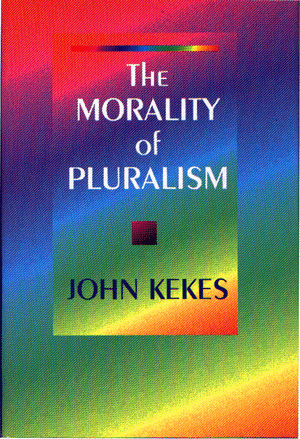
Current controversies about abortion, the environment, pornography, AIDS, capital punishment, and similar issues naturally lead to the question of whether there are any values that can be ultimately justified, or whether values are simply conventional. John Kekes argues that the present moral and political uncertainties are due to a deep change in our society from a dogmatic to a pluralistic view of values. Dogmatism is committed to there being only one justifiable system of values. Pluralism recognizes many such systems, and yet it avoids a chaotic relativism according to which all values are in the end arbitrary. Maintaining that good lives must be reasonable, but denying that they must conform to one true pattern, Kekes develops and justifies a pluralistic account of good lives and values, and works out its political, moral, and personal implications. The author defines values as possibilities whose realization would make lives good. He recognizes that their realization is difficult, especially since it involves choices among many, often conflicting, values. He argues, however, that living a good life requires a resolution of these conflicts, although reasonable resolutions are themselves plural in nature. His central claim is that pluralism is both reasonable and a preferable alternative to dogmatism and relativism.
With formal ethics education programmes being a rarity in most countries’ armed forces, there is a growing importance for servicemen to undergo additional military ethics training. But how do we ensure that soldiers learn the right lessons from it? Furthermore, how can we achieve a uniformity of approach? The current lack of uniformity about what constitutes ethical behaviour and how troops should be educated in it is potentially a cause for serious alarm.This book advances knowledge and understanding of the issues associated with this subject by bringing together experts from around the world to analyze the content, mode of instruction, theoretical underpinnings, and the effect of cultural and national differences within current ethics programmes. It also explores whether such programmes are best run by military officers, chaplains or academic philosophers, and reflects whether it is feasible to develop common principles and approaches for the armed forces of all Western countries.This is an invaluable volume for military academies and staff colleges to enhance understanding of a matter which requires much further thought and which is becoming a vital force in influencing outcomes on the battlefields of the twenty-first century. The book will primarily be of interest to military officers and others directly involved in ethics education in the military, as well as to philosophers and students of military affairs.
” . . . one of the most important works on philosophical ethics written in recent years. . . . Caputo speaks with a passion and a concern that are rare in academic philosophy. His profound sense of humor deepens the passion of the viewpoints he develops.Oacute; Ntilde;Mark C. Taylor Ograve; . . . a counterethics whose multiple voices will be heard long after the trivializing arguments of many analytic ethicists have vanished and the arcane formulations of many postmoderns jettisoned. . . . The either/or of this dialogue is shown as the topos of a postmodern ethics.Oacute; Ntilde;Edith Wyschogrod In Against Ethics John D. Caputo undertakes a passionate, poetic, and satiric search for the basis of an ethics in the postmodern situation. Restaging Fear and Trembling, Caputo defends the notion of obligation without ethics, of responsibility without the support of ethical foundations. Retelling the story of Abraham and Isaac, Caputo strikes the pose of a postmodern-day Johannes de Silentio, accompanied by communications from such startling figures as Johanna de Silentio, Felix Sineculpa, and Magdalena de la Cruz. In dialogue with the thought of Kierkegaard, Nietzsche, Levinas, Derrida, and Lyotard, Caputo forges a challenging, original account of what is possible and what is not possible for a continentalist ethics today.
ما از اخلاق چه انتظاری داریم؟ این سوال شاید تاحدودی برای عموم مردم و یا متخصصان این رشته قابل پاسخ باشد؛ اینکه خوب بودن را به ما بیاموزد و در تنظیم روابط فردی م...

جشن کتاب تهران به ایستگاه سی و یکم رسیده است. حال و احوال نشر کتاب خوب نیست و باید فرهنگدوستان را به خرید و هدیه دادن کتاب ترغیب نمود. خانه اخلاقپژوهان جوان ب...

بنیاد کتابهای اخلاق اسلامی عمدتا پالایش جان از آلودگیها و آراستن آن به زیباییها است. اندیشه محوری این قبیل کتابها آن است که انسان فعلی آنی نیست که باید باشد...

-
0 Comments