Notice: تابع WP_Block_Type_Registry::register به طورنادرست فراخوانی شد. نامهای نوع بلوک نباید حروف بزرگ داشته باشند. لطفاً برای اطلاعات بیشتر، اشکال زدایی در وردپرس را مشاهده کنید. (این پیام در نگارش 5.0.0 افزوده شده است.) in /home/ethicsho/public_html/wp-includes/functions.php on line 5313
Warning: Use of undefined constant TDC_PATH_LEGACY - assumed 'TDC_PATH_LEGACY' (this will throw an Error in a future version of PHP) in /home/ethicsho/public_html/wp-content/plugins/td-composer/td-composer.php on line 109
Warning: Use of undefined constant TDSP_THEME_PATH - assumed 'TDSP_THEME_PATH' (this will throw an Error in a future version of PHP) in /home/ethicsho/public_html/wp-content/plugins/td-composer/td-composer.php on line 113 بایگانیهای Gerard Hughes - خانه اخلاق پژوهان جوان Notice: Trying to access array offset on value of type bool in /home/ethicsho/public_html/wp-content/plugins/wp-ulike/inc/general-functions.php on line 807
“Ethics and the Limits of Philosophy” is widely acknowledged to be Bernard Williams’ most important book and a contemporary classic of moral philosophy. Delivering a sustained critique of moral theory from Kant onward, Williams reorients ethical theory towards “truth, truthfulness and the meaning of an individual life.” He explores and reflects on the thorniest problems in contemporary philosophy and offers new ideas about central issues such as relativism, objectivity and the possibility of ethical knowledge.This edition includes a new commentary on the text by A.W.Moore, St.Hugh’s College, Oxford.By the time of his death in 2003, Bernard Williams was one of the greatest philosophers of his generation. He taught at the Universities of Cambridge, Berkeley and Oxford. He is the author of M”orality; Utilitarianism: For and” “Against; Descartes: The Project of Pure Enquiry and Truth and Truthfulness.”
What is a human right? How can we tell whether a proposed human right really is one? How do we establish the content of particular human rights, and how do we resolve conflicts between them? These are pressing questions for philosophers, political theorists, jurisprudents, international lawyers, and activists. James Griffin offers answers in his compelling new investigation of the foundations of human rights. First, On Human Rights traces the idea of a natural right from its origin in the late Middle Ages, when the rights were seen as deriving from natural laws, through the seventeenth and eighteenth centuries, when the original theological background was progressively dropped and ‘natural law’ emptied of most of its original meaning. By the end of the Enlightenment, the term “human rights” (droits de l’homme) appeared, marking the purge of the theological background. But the Enlightenment, in putting nothing in its place, left us with an unsatisfactory, incomplete idea of a human right. Griffin shows how the language of human rights has become debased. There are scarcely any accepted criteria, either in the academic or the public sphere, for correct use of the term. He takes on the task of showing the way towards a determinate concept of human rights, based on their relation to the human status that we all share. He works from certain paradigm cases, such as freedom of expression and freedom of worship, to more disputed cases such as welfare rights–for instance the idea of a human right to health. His goal is a substantive account of human rights–an account with enough content to tell us whether proposed rights really are rights. Griffin emphasizes the practical as well as theoretical urgency of this goal: as the United Nations recognized in 1948 with its Universal Declaration, the idea of human rights has considerable power to improve the lot of humanity around the world. We can’t do without the idea of human rights, and we need to get clear about it. It is our job now–the job of this book–to influence and develop the unsettled discourse of human rights so as to complete the incomplete idea.
How can we establish a political/legal order that in principles does not require the human flourishing of any person or group to be given structured preference over that of any other? Addressing this question as the central problem of political philosophy, Norms of Liberty offers a new conceptual foundation for political liberalism that takes protecting liberty, understood in terms of individual negative rights, as the primary aim of the political/legal order. Rasmussen and Den Uyl argue for construing individual rights as metanormative principles, directly tied to politics, that are used to establish the political/legal conditions under which full moral conduct can take place. These they distinguish from normative principles, used to provide guidance for moral conduct within the ambit of normative ethics. This crucial distinction allows them to develop liberalism as a metanormative theory, not a guide for moral conduct. The moral universe need not be minimized or morality grounded in sentiment or contracts to support liberalism, they show. Rather, liberalism can be supported, and many of its internal tensions avoided, with an ethical framework of Aristotelian inspiration–one that understands human flourishing to be an objective, inclusive, individualized, agent-relative, social, and self-directed activity.
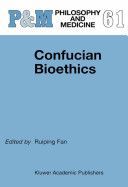
This volume explores Confucian views regarding the human body, health, virtue, suffering, suicide, euthanasia, `human drugs,’ human experimentation, and justice in health care distribution. These views are rooted in Confucian metaphysical, cosmological, and moral convictions, which stand in contrast to modern Western liberal perspectives in a number of important ways. In the contemporary world, a wide variety of different moral traditions flourish; there is real moral diversity. Given this circumstance, difficult and even painful ethical conflicts often occur between the East and the West with regard to the issues of life, birth, reproduction, and death. The essays in this volume analyze the ways in which Confucian bioethics can clarify important moral concepts, provide arguments, and offer ethical guidance. The volume should be of interest to both general readers coming afresh to the study of bioethics, ethics, and Confucianism, as well as for philosophers, ethicists, and other scholars already familiar with the subject.
ما از اخلاق چه انتظاری داریم؟ این سوال شاید تاحدودی برای عموم مردم و یا متخصصان این رشته قابل پاسخ باشد؛ اینکه خوب بودن را به ما بیاموزد و در تنظیم روابط فردی م...

جشن کتاب تهران به ایستگاه سی و یکم رسیده است. حال و احوال نشر کتاب خوب نیست و باید فرهنگدوستان را به خرید و هدیه دادن کتاب ترغیب نمود. خانه اخلاقپژوهان جوان ب...

بنیاد کتابهای اخلاق اسلامی عمدتا پالایش جان از آلودگیها و آراستن آن به زیباییها است. اندیشه محوری این قبیل کتابها آن است که انسان فعلی آنی نیست که باید باشد...

-
0 Comments