Notice: تابع WP_Block_Type_Registry::register به طورنادرست فراخوانی شد. نامهای نوع بلوک نباید حروف بزرگ داشته باشند. لطفاً برای اطلاعات بیشتر، اشکال زدایی در وردپرس را مشاهده کنید. (این پیام در نگارش 5.0.0 افزوده شده است.) in /home/ethicsho/public_html/wp-includes/functions.php on line 5313
Warning: Use of undefined constant TDC_PATH_LEGACY - assumed 'TDC_PATH_LEGACY' (this will throw an Error in a future version of PHP) in /home/ethicsho/public_html/wp-content/plugins/td-composer/td-composer.php on line 109
Warning: Use of undefined constant TDSP_THEME_PATH - assumed 'TDSP_THEME_PATH' (this will throw an Error in a future version of PHP) in /home/ethicsho/public_html/wp-content/plugins/td-composer/td-composer.php on line 113 بایگانیهای Fiona Robinson - خانه اخلاق پژوهان جوان Notice: Trying to access array offset on value of type bool in /home/ethicsho/public_html/wp-content/plugins/wp-ulike/inc/general-functions.php on line 807
This book studies education and curriculum from the perspective of the teacher’s stance in the classroom. Writing through the lenses offered by autobiography, a lifetime in the classroom serving as teacher, and drawing heavily on Jewish and secular scholarly texts, Block offers a vision of education that serves as an alternative to the increasingly instrumentalist, managerial, standards-driven impersonal nature of contemporary schools. He advocates not for a pedagogy of ethics, but for the original ethical stance every teacher already assumes by entering into the classroom. It is from this stance in ethics, he argues, that all pedagogy derives.
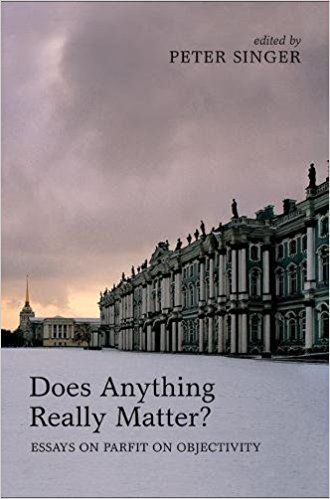
“In the first two volumes of On What Matters Derek Parfit argues that there are objective moral truths, and other normative truths about what we have reasons to believe, and to want, and to do. He thus challenges a view of the role of reason in action that can be traced back to David Hume, and is widely assumed to be correct, not only by philosophers but also by economists. In defending his view, Parfit argues that if there are no objective normative truths, nihilism follows, and nothing matters. He criticizes, often forcefully, many leading contemporary philosophers working on the nature of ethics, including Simon Blackburn, Stephen Darwall, Allen Gibbard, Frank Jackson, Peter Railton, Mark Schroeder, Michael Smith, and Sharon Street. ‘Does Anything Really Matter?’ gives these philosophers an opportunity to respond to Parfit’s criticisms, and includes essays on Parfit’s views by Richard Chappell, Andrew Huddleston, Katarzyna de Lazari-Radek and Peter Singer, Bruce Russell, and Larry Temkin. A third volume of On What Matters, in which Parfit engages with his critics and breaks new ground in finding significant agreement between his own views and theirs, is appearing as a separate companion volume.”–
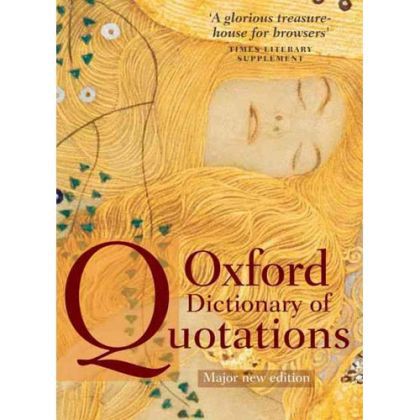
Here is a major new edition of the most authoritative dictionary of quotations available, bringing you the wit and wisdom of past and present–from the ancient adages of East and West to today’s most memorable lines. This new edition is a paradise of over 20,000 quotations for all occasions, comprehensively indexed by keyword. Whether you lean towards the words of Jane Austen: “Think only of the past as its remembrance gives you pleasure,” or the advice of Paris Hilton: “Dress cute wherever you go. Life is too short to blend in,” the Oxford Dictionary of Quotations provides the ultimate answer to the questions “Who said that?” and “What’s been said about this?” Drawing on Oxford’s unrivalled dictionary research program and unique language monitoring, this Seventh Edition offers almost a thousand new quotations, from over 500 authors. These include classic quotations from established names for which new evidence of current usage has been found as well as earlier quotations used by well-known literary authors from around the English-speaking world, ranging from the maxim of Confucius for a ruler, “If you desire what is good, the people will be good” (quoted by Thoreau), and the view of the Stoic philosopher Epictetus that “Not things, but opinions about things, trouble men” (Laurence Sterne). Now featuring a ribbon-marker, enhanced cross-referencing, a new crystal-clear text design, and an expanded introduction, The Oxford Dictionary of Quotations is an invaluable addition to every home library as well as the working libraries of all professional speakers and writers.
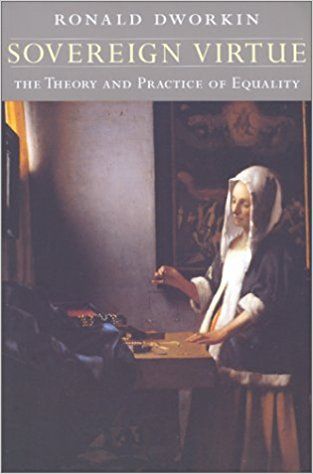
Equality is the endangered species of political ideals. Even left-of-center politicians reject equality as an ideal: government must combat poverty, they say, but need not strive that its citizens be equal in any dimension. In his new book Ronald Dworkin insists, to the contrary, that equality is the indispensable virtue of democratic sovereignty. A legitimate government must treat all its citizens as equals, that is, with equal respect and concern, and, since the economic distribution that any society achieves is mainly the consequence of its system of law and policy, that requirement imposes serious egalitarian constraints on that distribution. What distribution of a nation’s wealth is demanded by equal concern for all? Dworkin draws upon two fundamental humanist principles–first, it is of equal objective importance that all human lives flourish, and second, each person is responsible for defining and achieving the flourishing of his or her own life–to ground his well-known thesis that true equality means equality in the value of the resources that each person commands, not in the success he or she achieves. Equality, freedom, and individual responsibility are therefore not in conflict, but flow from and into one another as facets of the same humanist conception of life and politics. Since no abstract political theory can be understood except in the context of actual and complex political issues, Dworkin develops his thesis by applying it to heated contemporary controversies about the distribution of health care, unemployment benefits, campaign finance reform, affirmative action, assisted suicide, and genetic engineering.
ما از اخلاق چه انتظاری داریم؟ این سوال شاید تاحدودی برای عموم مردم و یا متخصصان این رشته قابل پاسخ باشد؛ اینکه خوب بودن را به ما بیاموزد و در تنظیم روابط فردی م...

جشن کتاب تهران به ایستگاه سی و یکم رسیده است. حال و احوال نشر کتاب خوب نیست و باید فرهنگدوستان را به خرید و هدیه دادن کتاب ترغیب نمود. خانه اخلاقپژوهان جوان ب...

بنیاد کتابهای اخلاق اسلامی عمدتا پالایش جان از آلودگیها و آراستن آن به زیباییها است. اندیشه محوری این قبیل کتابها آن است که انسان فعلی آنی نیست که باید باشد...

-
0 Comments