Notice: تابع WP_Block_Type_Registry::register به طورنادرست فراخوانی شد. نامهای نوع بلوک نباید حروف بزرگ داشته باشند. لطفاً برای اطلاعات بیشتر، اشکال زدایی در وردپرس را مشاهده کنید. (این پیام در نگارش 5.0.0 افزوده شده است.) in /home/ethicsho/public_html/wp-includes/functions.php on line 5313
Warning: Use of undefined constant TDC_PATH_LEGACY - assumed 'TDC_PATH_LEGACY' (this will throw an Error in a future version of PHP) in /home/ethicsho/public_html/wp-content/plugins/td-composer/td-composer.php on line 109
Warning: Use of undefined constant TDSP_THEME_PATH - assumed 'TDSP_THEME_PATH' (this will throw an Error in a future version of PHP) in /home/ethicsho/public_html/wp-content/plugins/td-composer/td-composer.php on line 113 بایگانیهای E. Kelly - خانه اخلاق پژوهان جوان Notice: Trying to access array offset on value of type bool in /home/ethicsho/public_html/wp-content/plugins/wp-ulike/inc/general-functions.php on line 807
If you’ve ever searched the web for information and wondered what’s going on behind that query box, I recommend you read Web Dragons. It puts Internet search engines in contextpart of a legacy of information access dating back thousands of years. It explains in plain language how search engines work, and points out potential pitfalls that thoughtful searchers should consider. Web Dragons is clear and engaging. Given the amount of time and trust we all invest in search engines, if you pay attention to the web I highly recommend redirecting some of that attention to this book. –Craig Nevill-Manning, Engineering Director, Google Search technology is changing the way people understand and interact with the world. Web Dragons takes a revealing look at the evolution of search and how it will shape the future of information technology. –Prabhakar Raghavan, Head of Yahoo! Research Witten, Gori and Numerico steadily bring the web into sharper and sharper focus. A daunting expanse is revealed to have structure. The structure enables the knowledgeable to navigate it to their benefit and allows the unscrupulous or careless to create pitfalls and traps. Search engines will be critical tools for most people living today. What could be more important than understanding how these technologies work and where they are going? –Jonathan Grudin, Microsoft Research In the eye-blink that has elapsed since the turn of the millennium, the lives of those of us who work with information have been utterly transformed. Pretty well all we need to know is on the web; if not today, then tomorrow. Its where we learn and play, shop and do business, keep up with old friends and meet new ones. What makes it possible for us to find the stuff we need to know? Search engines. Search enginesweb dragonsare the portals through which we access societys treasure trove of information. How do they stack up against librarians, the gatekeepers over centuries past? What role will libraries play in a world whose information is ruled by the web? How is the web organized? Who controls its contents, and how do they do it? How do search engines work? How can web visibility be exploited by those who want to sell us their wares? Whats coming tomorrow, and can we influence it? We are witnessing the dawn of a new era, starting right nowand this book shows you what it will look like and how it will change your world. Do you use search engines every day? Are you a developer or a librarian, helping others with their information needs? A researcher or journalist for whom the web has changed the very way you work? An online marketer or site designer, whose career exists because of the web? Whoever you are: if you care about information, this book will open your eyesand make you blink. About the authors: Ian H. Witten is professor of computer science at the University of Waikato, where he directs the New Zealand Digital Library research project. He has published widely on digital libraries, machine learning, text compression, hypertext, speech synthesis and signal processing, and computer typography. A fellow of the ACM, he has written several books, including How to Build a Digital Library (2002) and Data Mining (2005), both from Morgan Kaufmann. Marco Gori is professor of computer science at the University of Siena, where he leads the artificial intelligence research group. He is the Chairman of the Italian Chapter of the IEEE Computational Intelligence Society, a fellow of the IEEE and of the ECCAI, and former President of the Italian Association for Artificial Intelligence. Teresa Numerico teaches network theory and communication studies at the University of Rome 3, and is a researcher in Philosophy of Science at the University of Salerno. Previously she was employed as a business development and marketing manager for various media companies, including the Italian branch of Turner Broadcasting System (CNN and Cartoon
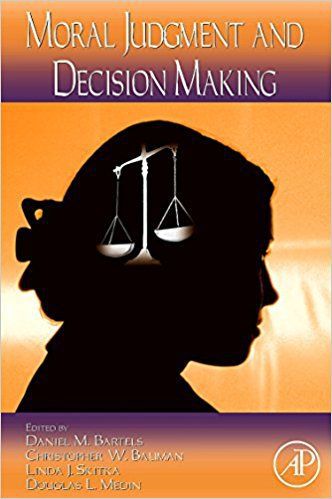
This volume presents a variety of perspectives from within and outside moral psychology. Recently there has been an explosion of research in moral psychology, but it is one of the subfields most in need of bridge-building, both within and across areas. Interests in moral phenomena have spawned several separate lines of research that appear to address similar concerns from a variety of perspectives. The contributions to this volume examine key theoretical and empirical issues these perspectives share that connect these issues with the broader base of theory and research in social and cognitive psychology. The first two chapters discuss the role of mental representation in moral judgment and reasoning. Sloman, Fernbach, and Ewing argue that causal models are the canonical representational medium underlying moral reasoning, and Mikhail offers an account that makes use of linguistic structures and implicates legal concepts. Bilz and Nadler follow with a discussion of the ways in which laws, which are typically construed in terms of affecting behavior, exert an influence on moral attitudes, cognition, and emotions. Baron and Ritov follow with a discussion of how people’s moral cognition is often driven by law-like rules that forbid actions and suggest that value-driven judgment is relatively less concerned by the consequences of those actions than some normative standards would prescribe. Iliev et al. argue that moral cognition makes use of both rules and consequences, and review a number of laboratory studies that suggest that values influence what captures our attention, and that attention is a powerful determinant of judgment and preference. Ginges follows with a discussion of how these value-related processes influence cognition and behavior outside the laboratory, in high-stakes, real-world conflicts. Two subsequent chapters discuss further building blocks of moral cognition. Lapsley and Narvaez discuss the development of moral characters in children, and Reyna and Casillas offer a memory-based account of moral reasoning, backed up by developmental evidence. Their theoretical framework is also very relevant to the phenomena discussed in the Sloman et al., Baron and Ritov, and Iliev et al. chapters. The final three chapters are centrally focused on the interplay of hot and cold cognition. They examine the relationship between recent empirical findings in moral psychology and accounts that rely on concepts and distinctions borrowed from normative ethics and decision theory. Connolly and Hardman focus on bridge-building between contemporary discussions in the judgment and decision making and moral judgment literatures, offering several useful methodological and theoretical critiques. Ditto, Pizarro, and Tannenbaum argue that some forms of moral judgment that appear objective and absolute on the surface are, at bottom, more about motivated reasoning in service of some desired conclusion. Finally, Bauman and Skitka argue that moral relevance is in the eye of the perceiver and emphasize an empirical approach to identifying whether people perceive a given judgment as moral or non-moral. They describe a number of behavioral implications of people’s reported perception that a judgment or choice is a moral one, and in doing so, they suggest that the way in which researchers carve out the moral domain a priori might be dubious.
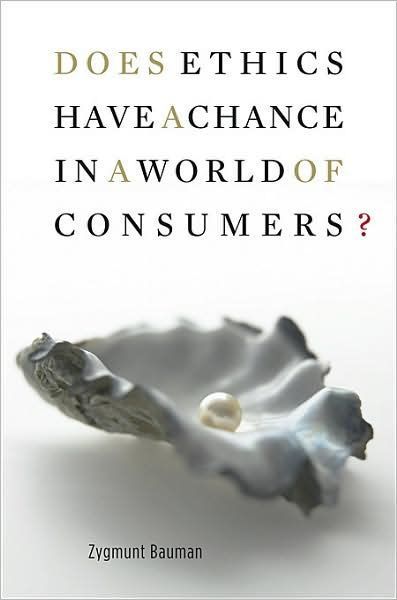
Zygmunt Bauman is one of the most admired social thinkers of our time. Once a Marxist sociologist, he has surrendered the narrowness of both Marxism and sociology, and dares to write in language that ordinary people can understand—about problems they feel ill equipped to solve. This book is no dry treatise but is instead what Bauman calls “a report from a battlefield,” part of the struggle to find new and adequate ways of thinking about the world in which we live. Rather than searching for solutions to what are perhaps the insoluble problems of the modern world, Bauman proposes that we reframe the way we think about these problems. In an era of routine travel, where most people circulate widely, the inherited beliefs that aid our thinking about the world have become an obstacle. Bauman seeks to liberate us from the thinking that renders us hopeless in the face of our own domineering governments and threats from unknown forces abroad. He shows us we can give up belief in a hierarchical arrangement of states and powers. He challenges members of the “knowledge class” to overcome their estrangement from the rest of society. Gracefully, provocatively, Bauman urges us to think in new ways about a newly flexible, newly challenging modern world. As Bauman notes, quoting Vaclav Havel, “hope is not a prognostication.” It is, rather, alongside courage and will, a mundane, common weapon that is too seldom used.
Michael Ryan (d. 1840) remains one of the most mysterious figures in the history of medical ethics, despite the fact that he was the only British physician during the middle years of the 19th century to write about ethics in a systematic way. Michael Ryan s Writings on Medical Ethics offers both an annotated reprint of his key ethical writings, and an extensive introductory essay that fills in many previously unknown details of Ryan s life, analyzes the significance of his ethical works, and places him within the historical trajectory of the field of medical ethics.
ما از اخلاق چه انتظاری داریم؟ این سوال شاید تاحدودی برای عموم مردم و یا متخصصان این رشته قابل پاسخ باشد؛ اینکه خوب بودن را به ما بیاموزد و در تنظیم روابط فردی م...

جشن کتاب تهران به ایستگاه سی و یکم رسیده است. حال و احوال نشر کتاب خوب نیست و باید فرهنگدوستان را به خرید و هدیه دادن کتاب ترغیب نمود. خانه اخلاقپژوهان جوان ب...

بنیاد کتابهای اخلاق اسلامی عمدتا پالایش جان از آلودگیها و آراستن آن به زیباییها است. اندیشه محوری این قبیل کتابها آن است که انسان فعلی آنی نیست که باید باشد...

-
0 Comments