Notice: تابع WP_Block_Type_Registry::register به طورنادرست فراخوانی شد. نامهای نوع بلوک نباید حروف بزرگ داشته باشند. لطفاً برای اطلاعات بیشتر، اشکال زدایی در وردپرس را مشاهده کنید. (این پیام در نگارش 5.0.0 افزوده شده است.) in /home/ethicsho/public_html/wp-includes/functions.php on line 5313
Warning: Use of undefined constant TDC_PATH_LEGACY - assumed 'TDC_PATH_LEGACY' (this will throw an Error in a future version of PHP) in /home/ethicsho/public_html/wp-content/plugins/td-composer/td-composer.php on line 109
Warning: Use of undefined constant TDSP_THEME_PATH - assumed 'TDSP_THEME_PATH' (this will throw an Error in a future version of PHP) in /home/ethicsho/public_html/wp-content/plugins/td-composer/td-composer.php on line 113 بایگانیهای Charles L. Stevenson - خانه اخلاق پژوهان جوان Notice: Trying to access array offset on value of type bool in /home/ethicsho/public_html/wp-content/plugins/wp-ulike/inc/general-functions.php on line 807
Fichte’s System of Ethics, originally published in 1798, is at once the most accessible presentation of its author’s comprehensive philosophical project, The Science of Knowledge or Wissenschaftslehre, and the most important work in moral philosophy written between Kant and Hegel. This study integrates the discussion of our moral duties into the systematic framework of a transcendental theory of the human subject. Ranging over numerous important philosophical themes, the volume offers a new translation of the work together with an introduction that sets it in its philosophical and historical contexts.
Pharmaceutical Ethics is an important text, which aims to provide the ethical guidelines much needed by the pharmaceutical industry. By focusing on many of the central issues such as the ethical aspects of clinical trials, informed consent, physician or patient choice and pharmaceutical advertising, this text will provide very good coverage of an area which perhaps still lacks coherent instruction. * Covers ethical issues involved in the testing and use of pharmaceuticals on human beings * Investigates issues such as whether choice of drug should lie with the physician or the patient * Looks at a wide variety of subjects connected with pharmaceutical ethics. * Focuses specifically on the issues surrounding the pharmaceutical industry, not medicine in general. * Fulfils an important need in the Pharmaceutical Industry.
One of the world’s most famous philosophers, Jacques Derrida, explores difficult questions in this important and engaging book. Is it still possible to uphold international hospitality and justice in the face of increasing nationalism and civil strife in so many countries? Drawing on examples of treatment of minority groups in Europe, he skillfully and accessibly probes the thinking that underlies much of the practice, and rhetoric, that informs cosmopolitanism. What have duties and rights to do with hospitality? Should hospitality be grounded in a private or public ethic, or even a religious one? This fascinating book will be illuminating reading for all.
Is medical ethics in times of armed conflict identical to medical ethics in times of peace, as the World Medical Association declares? In Bioethics and Armed Conflict, the first comprehensive study of medical ethics in conventional, unconventional, and low-intensity war, Michael Gross examines the dilemmas that arise when bioethical principles clash with military necessity—when physicians try to save lives during an endeavor dedicated to taking them—and describes both the conflicts and congruencies of military and medical ethics.Gross describes how the principles of contemporary just war, unlike those of medical ethics, often go beyond the welfare of the individual to consider the collective interests of combatants and noncombatants and the general interests of the state. Military necessity plays havoc with such patients’ rights as the right to life, the right to medical care, informed consent, confidentiality, and the right to die. The principles of triage in battle conditions dictate not need-based treatment but the distribution of resources that will return the greatest number of soldiers to active duty. And unconventional warfare, including current “wars” on terrorism, challenges the traditional concept of medical neutrality as physicians who have sworn to “do no harm” are called upon to lend their expertise to “interrogational” torture or to the development of biological or chemical weapons. Difficult dilemmas inevitably arise during armed conflict, and medicine, Gross concludes, is not above the fray. Medical ethics in time of war cannot be identical to medical ethics in peacetime.
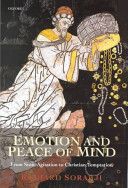
Richard Sorabji presents a ground-breaking study of ancient Greek views of the emotions and their influence on subsequent theories and attitudes, pagan and Christian. The key questions are ones that concern everyone: what is emotion, and how does one cope with one’s own emotions and establish peace of mind? The central focus of the book is the Stoics, but Sorabji draws on a vast range of texts to give a rich historical survey of how Western thinking about this central aspect of human nature developed. The result is a magisterial work of scholarship which will be fascinating for anyone with an interest in the emotions from a historical or contemporary perspective.
ما از اخلاق چه انتظاری داریم؟ این سوال شاید تاحدودی برای عموم مردم و یا متخصصان این رشته قابل پاسخ باشد؛ اینکه خوب بودن را به ما بیاموزد و در تنظیم روابط فردی م...

جشن کتاب تهران به ایستگاه سی و یکم رسیده است. حال و احوال نشر کتاب خوب نیست و باید فرهنگدوستان را به خرید و هدیه دادن کتاب ترغیب نمود. خانه اخلاقپژوهان جوان ب...

بنیاد کتابهای اخلاق اسلامی عمدتا پالایش جان از آلودگیها و آراستن آن به زیباییها است. اندیشه محوری این قبیل کتابها آن است که انسان فعلی آنی نیست که باید باشد...

-
0 Comments