Notice: تابع WP_Block_Type_Registry::register به طورنادرست فراخوانی شد. نامهای نوع بلوک نباید حروف بزرگ داشته باشند. لطفاً برای اطلاعات بیشتر، اشکال زدایی در وردپرس را مشاهده کنید. (این پیام در نگارش 5.0.0 افزوده شده است.) in /home/ethicsho/public_html/wp-includes/functions.php on line 5313
Warning: Use of undefined constant TDC_PATH_LEGACY - assumed 'TDC_PATH_LEGACY' (this will throw an Error in a future version of PHP) in /home/ethicsho/public_html/wp-content/plugins/td-composer/td-composer.php on line 109
Warning: Use of undefined constant TDSP_THEME_PATH - assumed 'TDSP_THEME_PATH' (this will throw an Error in a future version of PHP) in /home/ethicsho/public_html/wp-content/plugins/td-composer/td-composer.php on line 113 بایگانیهای Chaim Gans - خانه اخلاق پژوهان جوان Notice: Trying to access array offset on value of type bool in /home/ethicsho/public_html/wp-content/plugins/wp-ulike/inc/general-functions.php on line 807
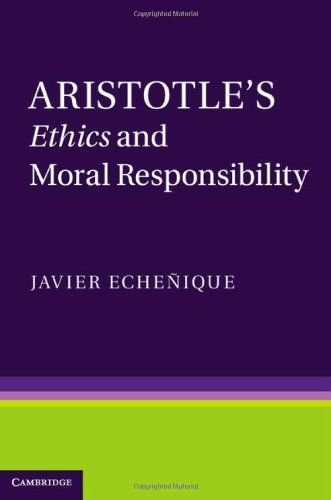
“Aristotle’s Ethics develops a complex theory of the qualities which make for a good human being and for several decades there has been intense discussion about whether Aristotle’s theory of voluntariness, outlined in the Ethics, actually delineates what modern thinkers would recognize as a theory of moral responsibility. Javier Echeñique presents a novel account of Aristotle’s discussion of voluntariness in the Ethics, arguing – against the interpretation by Arthur Adkins and that inspired by Peter Strawson – that he developed an original and compelling theory of moral responsibility and that this theory has contributed in important ways to our understanding of coercion, ignorance and violence. His study will be valuable for a wide range of readers interested in Aristotle and in ancient ethics more broadly”–
One of the world’s most important political philosophers, Jon Elster is a leading thinker on reason and rationality and their roles in politics and public life. In this short book, he crystallizes and advances his work, bridging the gap between philosophers who use the idea of reason to assess human behavior from a normative point of view and social scientists who use the idea of rationality to explain behavior. In place of these approaches, Elster proposes a unified conceptual framework for the study of behavior.Drawing on classical moralists as well as modern scholarship, and using a wealth of historical and contemporary illustrations,Reason and Rationalitymarks a new development in Elster’s thinking while at the same time providing a brief, elegant, and accessible introduction to his work.
Because of the didactic nature of the historical genre, many scholars ancient and modern have seen connections between history and rhetoric. So far, discussion has centered on fifth-century authors — Herodotus and Thucydides, along with the sophists and early philosophers. Pownall extends the focus of this discussion into an important period. By focusing on key intellectuals and historians of the fourth century (Plato and the major historians — Xenophon, Ephorus, and Theopompus), she examines how these prose writers created an aristocratic version of the past as an alternative to the democratic version of the oratorical tradition.Frances Pownall is Professor of History and Classics, University of Alberta.
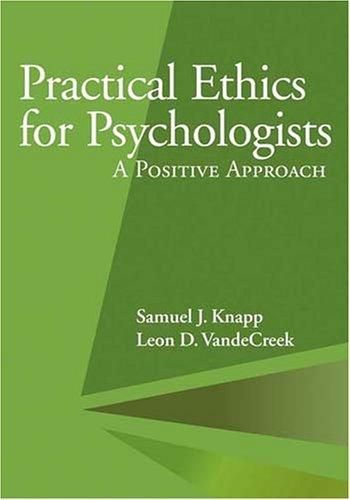
Helps psychologists clarify what they value, consider how they should behave, and determine what constitutes proper professional conduct. This book is unique in stressing the importance of positive ethics?that is, ways in which psychologists can reach their highest ethical ideals, rather than just avoiding breaking rules. Using the 2002 APA Code of Ethics as a guide, the authors lay out a five-step model for resolving ethical dilemmas, illustrating the discussion with thumbnail sketches of both ethical and questionable behaviors. Throughout, they stress the importance of self-care, which involves self-regulation, emotional competence, and an understanding of the unique occupational challenges of being a psychologist. Provides guidance on dealing with ethically complex issues like competence, multiple relationships, informed consent, confidentiality (including confidentiality with life endangering patients), fees and financial issues, public statements, and risk management. Individual chapters are devoted to special issues for psychologists working in forensics, teaching, business, assessment, therapy, and supervision and training. This book is ideal for classroom use or self-study.
ما از اخلاق چه انتظاری داریم؟ این سوال شاید تاحدودی برای عموم مردم و یا متخصصان این رشته قابل پاسخ باشد؛ اینکه خوب بودن را به ما بیاموزد و در تنظیم روابط فردی م...

جشن کتاب تهران به ایستگاه سی و یکم رسیده است. حال و احوال نشر کتاب خوب نیست و باید فرهنگدوستان را به خرید و هدیه دادن کتاب ترغیب نمود. خانه اخلاقپژوهان جوان ب...

بنیاد کتابهای اخلاق اسلامی عمدتا پالایش جان از آلودگیها و آراستن آن به زیباییها است. اندیشه محوری این قبیل کتابها آن است که انسان فعلی آنی نیست که باید باشد...

-
0 Comments