Notice: تابع WP_Block_Type_Registry::register به طورنادرست فراخوانی شد. نامهای نوع بلوک نباید حروف بزرگ داشته باشند. لطفاً برای اطلاعات بیشتر، اشکال زدایی در وردپرس را مشاهده کنید. (این پیام در نگارش 5.0.0 افزوده شده است.) in /home/ethicsho/public_html/wp-includes/functions.php on line 5313
Warning: Use of undefined constant TDC_PATH_LEGACY - assumed 'TDC_PATH_LEGACY' (this will throw an Error in a future version of PHP) in /home/ethicsho/public_html/wp-content/plugins/td-composer/td-composer.php on line 109
Warning: Use of undefined constant TDSP_THEME_PATH - assumed 'TDSP_THEME_PATH' (this will throw an Error in a future version of PHP) in /home/ethicsho/public_html/wp-content/plugins/td-composer/td-composer.php on line 113 بایگانیهای Brent Lovelock - خانه اخلاق پژوهان جوان Notice: Trying to access array offset on value of type bool in /home/ethicsho/public_html/wp-content/plugins/wp-ulike/inc/general-functions.php on line 807
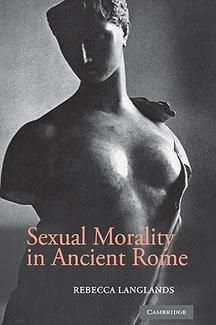
Traditionally, scholars have approached Roman sexuality using categories of sexual ethics drawn from contemporary, Western society. In this book Dr Langlands seeks to move away from these towards a deeper understanding of the issues that mattered to the Romans themselves, and the ways in which they negotiated them, by focusing on the untranslatable concept of pudicitia (broadly meaning ‘sexual virtue’). She offers a series of nuanced close readings of texts from a wide spectrum of Latin literature, including history, oratory, love poetry and Valerius Maximus’ work Memorable Deeds and Sayings. Pudicitia emerges as a controversial and unsettled topic, at the heart of Roman debates about the difference between men and women, the relation between mind and body, and the ethics of power and status differentiation within Roman culture. The book develops strategies for approaching the study of an ancient culture through sensitive critical readings of its literary productions.
Is the point of belief and assertion invariably to think or say something true? Is the truth of a belief or assertion absolute, or is it only relative to human interests? Most philosophers think it incoherent to profess to believe something but not think it true, or to say that some of the things we believe are only relatively true. Common sense disagrees. It sees many opinions, such as those about matters of taste, as neither true nor false; it takes it as obvious that some ofthe truth is relative.Mark Richard’s accessible book argues that when it comes to truth, common sense is right, philosophical orthodoxy wrong. The first half of the book examines connections between the performative aspects of talk (what we do when we speak), our emotions and evaluations, and the conditions under which talk and thought qualifies as true or false. It argues that the performative and expressive sometimes trump the semantic, making truth and falsity the wrong dimension of evaluation for belief orassertion. Among the topics taken up are: racial slurs and other epithets; relations between logic and truth; the status of moral and ethical talk; vagueness and the liar paradox. The book’s second half defends the idea that much of everyday thought and talk is only relatively true or false. Truth isinevitably relative, given that we cannot work out in advance how our concepts will apply to the world. Richard explains what it is for truth to be relative, rebuts standard objections to relativism, and argues that relativism is consistent with the idea that one view can be objectively better than another. The book concludes with an account of matters of taste and of how it is possible for divergent views of such matters to be equally valid, even if not true or false.When Truth Gives Out will be of interest not only to philosophers who work on language, ethics, knowledge, or logic, but to any thoughtful person who has wondered what it is, or isn’t, for something to be true.
This unique volume offers an odyssey through the ideas of the Stoics in three particular ways: first, through the historical trajectory of the school itself and its influence; second, through the recovery of the history of Stoic thought; third, through the ongoing confrontation with Stoicism, showing how it refines philosophical traditions, challenges the imagination, and ultimately defines the kind of life one chooses to lead. A distinguished roster of specialists have written an authoritative guide to the entire philosophical tradition. The first two chapters chart the history of the school in the ancient world, and are followed by chapters on the core themes of the Stoic system: epistemology, logic, natural philosophy, theology, determinism, and metaphysics. There are two chapters on what might be thought of as the heart and soul of the Stoics system: ethics.
ما از اخلاق چه انتظاری داریم؟ این سوال شاید تاحدودی برای عموم مردم و یا متخصصان این رشته قابل پاسخ باشد؛ اینکه خوب بودن را به ما بیاموزد و در تنظیم روابط فردی م...

جشن کتاب تهران به ایستگاه سی و یکم رسیده است. حال و احوال نشر کتاب خوب نیست و باید فرهنگدوستان را به خرید و هدیه دادن کتاب ترغیب نمود. خانه اخلاقپژوهان جوان ب...

بنیاد کتابهای اخلاق اسلامی عمدتا پالایش جان از آلودگیها و آراستن آن به زیباییها است. اندیشه محوری این قبیل کتابها آن است که انسان فعلی آنی نیست که باید باشد...

-
0 Comments