Notice: تابع WP_Block_Type_Registry::register به طورنادرست فراخوانی شد. نامهای نوع بلوک نباید حروف بزرگ داشته باشند. لطفاً برای اطلاعات بیشتر، اشکال زدایی در وردپرس را مشاهده کنید. (این پیام در نگارش 5.0.0 افزوده شده است.) in /home/ethicsho/public_html/wp-includes/functions.php on line 5313
Warning: Use of undefined constant TDC_PATH_LEGACY - assumed 'TDC_PATH_LEGACY' (this will throw an Error in a future version of PHP) in /home/ethicsho/public_html/wp-content/plugins/td-composer/td-composer.php on line 109
Warning: Use of undefined constant TDSP_THEME_PATH - assumed 'TDSP_THEME_PATH' (this will throw an Error in a future version of PHP) in /home/ethicsho/public_html/wp-content/plugins/td-composer/td-composer.php on line 113 بایگانیهای Anne Thomson - خانه اخلاق پژوهان جوان Notice: Trying to access array offset on value of type bool in /home/ethicsho/public_html/wp-content/plugins/wp-ulike/inc/general-functions.php on line 807
Intellectual property (IP) is a crucial contributor to economic growth and competitiveness within the EU. This book offers a compact and accessible account of EU intellectual property law and policy, covering copyright, patents, designs, trademarks and the enforcement of rights. The author also addresses aspects of the free movement of goods and services, competition law, customs measures and anti-counterfeiting efforts. Setting EU intellectual property law in its wider international context, this work reveals the framework within which the national IP laws of member states operate. The book seeks to highlight the most important policy issues and arguments of relevance to the EU, both within the Union, and in its relations with the rest of the world. With its the detailed references, cross-referencing and suggestions for further readings, EU Intellectual Property Law and Policy is essential reading for postgraduate students and academic lawyers in IP and EU law. Practitioners seeking a broad account of the area will also appreciate this important contribution.
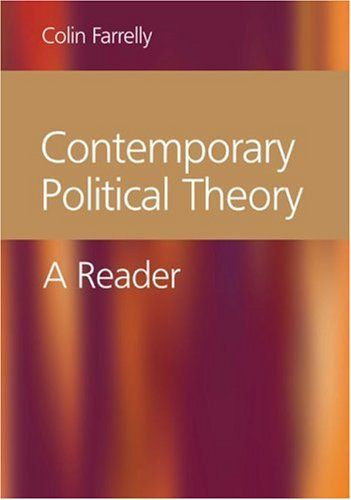
`Colin Farrelly has gathered together in one volume several of the key texts that have shaped recent developments in political theory. The structure of the book reflects that of many courses offering surveys of recent debates between liberals and their critics. It is an excellent teaching resource’ – Shane O’Neill, Queen’s University, Belfast `An excellent selection of key pieces that have shaped the debates that dominate contemporary political philosophy. Each section is prefaced with a clear and insightful introduction which gives a valuable commentary on each piece, sets it in its context, and indicates its influence on the field. This book will be a very useful resource for students of these debates from all backgrounds’ – Catriona McKinnon, University of York Contemporary Political Theory provides an accessible introduction to the key works of major contemporary political theorists. Key theorists and writers include John Rawls, Robert Nozick, Michael Walzer, Michael Sandel, Susan Okin, Will Kymlicka, Iris Marion Young, Charles Taylor, Nancy Fraser and John Dryzek. The readings are organized thematically into seven sections on egalitarian-liberalism, libertarianism, communitarianism, republicanism, feminism, deliberative democracy, and multiculturalism. A substantial introduction is provided to each to identify the main issues and the significance of the carefully selected excerpts that follow. The result is a complete but concise guide through the literature and major topics and areas of debate in contemporary political theory and political philosophy. Colin Farrelly is Assistant Professor in the Department of Political Science at the University of Waterloo, Canada. Contemporary Political Theory: A Reader will complement his textbook Introduction to Contemporary Political Theory also published by SAGE Publications.
In this book Uwe Steinhoff describes and explains the basic tenets of just war theory and gives a precise, succinct and highly critical account of its present status and of the most important and controversial current debates surrounding it. Rejecting certain in effect medieval assumptions of traditional just war theory and advancing a liberal outlook, Steinhoff argues that every single individual is a legitimate authority and has under certain circumstances the right to declare war on others or the state. He also argues that the just cause cannot be established independently of the other criteria of jus ad bellum (the justification of entering a war), except for right intention, which he interprets more leniently than the tradition does. Turning to jus in bello (which governs the conduct of a war) he criticizes the Doctrine of Double Effect and concludes that insofar as wars kill innocents, and be it as “collateral damage”, they cannot be just but at best justified as the lesser evil. Steinhoff gives particular attention to the question why soldiers, allegedly, are legitimate targets and civilians not. Discussing four approaches to the explanation of the difference he argues that the four principles underlying them all need to be taken into account and outlines how their weighing can proceed if applied to concrete cases. The resulting approach does not square the distinction between legitimate and illegitimate targets with the distinction between soldiers and civilians, which has extremely important consequences for the conduct of war. Finally, Steinhoff analyses the concept of terrorism and argues that some forms of “terrorism” are actually not terrorism at all and that even terrorism proper can under certain circumstances be justified.
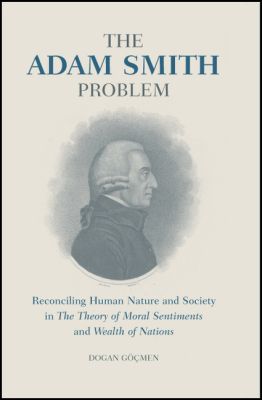
This is the first scholarly work to deal solely with the ‘Adam Smith problem’, namely the apparent contradiction between Adam Smith’s most famous works, The Theory of Moral Sentiments and The Nature and Causes of the Wealth of Nations. Since the 1840s scholars have puzzled over and attempted to explain the fact that these works offer two fundamentally different and contradictory concepts of human nature. In this radical new approach Dogan Göçmen makes a major contribution to the debate. Accepting that Smith does indeed put forward two different and varied ideas, he argues that the ethical position articulated in The Theory of Moral Sentiments can be, and was intended by Smith to be, applied as a basis for criticising the commercial society analysed in the Wealth of Nations. Göçmen argues that this ethical position points to the character of an ideal future society, Adam Smith’s Utopia, a society in which its social components are completely in sympathy – and therefore harmonious – with each other.
ما از اخلاق چه انتظاری داریم؟ این سوال شاید تاحدودی برای عموم مردم و یا متخصصان این رشته قابل پاسخ باشد؛ اینکه خوب بودن را به ما بیاموزد و در تنظیم روابط فردی م...

جشن کتاب تهران به ایستگاه سی و یکم رسیده است. حال و احوال نشر کتاب خوب نیست و باید فرهنگدوستان را به خرید و هدیه دادن کتاب ترغیب نمود. خانه اخلاقپژوهان جوان ب...

بنیاد کتابهای اخلاق اسلامی عمدتا پالایش جان از آلودگیها و آراستن آن به زیباییها است. اندیشه محوری این قبیل کتابها آن است که انسان فعلی آنی نیست که باید باشد...

-
0 Comments